Open web. Clear feed.

CM@gpu.net
AI budgets are leaking. Six out of ten organisations overspent last year, and half approved the money without knowing what the bill would actually look like. You can’t control costs you can’t forecast. Most companies are finding that out the hard way. Transparent pricing and flexible capacity aren’t nice-to-haves anymore. They’re the baseline. @gpunet was designed around both. world.gpu.net/

A major @Microsoft outage made something clear: if your AI stack lives inside one hyperscaler, you don’t control your uptime. One regional issue took Copilot, agents, and core workflows offline at the same time. Resilient systems don’t bet everything on a single provider. They route across independent infrastructure. @gpunet aggregates compute across 18 datacenters in 12 countries so one vendor’s outage never becomes your problem: world.gpu.net/

A $1.4 trillion valuation for Anthropic being treated as "modest" tells you everything about where AI capital is concentrated. That is enough capital to back 1,000,000 independent AI builders with $1M each. The next wave of AI breakthroughs won't come from one giant balance sheet it will come from removing the compute bottleneck for developers everywhere. Build without gatekeepers on @gpunet. Explore the ecosystem: world.gpu.net/

Board investigations. Congressional hearings. Geopolitical chokepoints. The global AI stack sounds like a political drama because silicon supply has become far too centralized. The real vulnerability is single-point dependency. Your ability to ship AI shouldn't rely on the fate of one boardroom or one executive. That is why we are building a distributed compute fabric at @gpunet: world.gpu.net/

**1/7** Most AI teams pick compute providers with a broken framework. They scan top-10 listicles, compare raw H100 hourly rates, and choose the cheapest option. Six months later, they’re locked in. Here’s the framework that actually works for where to run your AI workloads. **2/7** Stop asking “Which provider is best?” Ask these five questions first: • Workload shape: Heavy batch training or 24/7 low-latency inference? • Budget stage: Bursty pre-seed testing or steady-state Series A scaling? • DevOps bandwidth: Can your team orchestrate multi-provider infrastructure? • Compliance: Do you need strict HIPAA/SOC 2 regional boundaries? • Growth spikes: Can your infrastructure scale 10× instantly without quota delays? **3/7** Understand the market split: • Hyperscalers (AWS/GCP): Strong IAM/MLOps ecosystems and compliance, but premium pricing, high egress fees, and slow quota approvals. • Neoclouds: Fast raw compute, yet you bet uptime on a single vendor’s physical limits. • Aggregated fabrics (@gpunet): Global supply, lowest market-clearing rates, and dynamic scaling across distributed nodes. **4/7** The biggest rookie mistake is treating training and inference as the same workload. • Training: Needs massive centralized clusters, high inter-node bandwidth (NVLink), and “train once” batch economics. • Inference: Needs low latency, regional distribution, fast cold starts, and ruthless cost-per-token optimization. You serve forever. Build the stack accordingly. **5/7** The staged roadmap for AI infrastructure: • Stage 1 (Pre-PMF): Stay 100% on-demand. Never lock into reserved contracts. Prioritize checkpointing discipline and flexible pay-per-hour compute. • Stage 2 (Early scale): Separate training and inference clusters. Run 60-day spend models to test if reserved silicon pays off. • Stage 3 (Scale): Abstract away single-vendor lock-in with open container standards and decentralized compute fabrics. **6/7** This is where @gpunet fits the modern AI stack. Instead of rigid cloud contracts or manual vendor negotiation, it unifies global compute supply into a single fabric: • NVIDIA H100s from $2.20/hr • Instant B200 & Blackwell reservations • OpenAI-compatible GLM 5.3 inference at $0.15/1M tokens **7/7** The future of production AI will not run on a single walled-garden cloud. It will run on a global compute fabric that routes workloads by cost, geography, and latency. Explore the full @gpunet compute, model, and yield ecosystem: world.gpu.net/


🌐 Explore the entire @gpunet ecosystem in one place All products & services on a single platform 👉 world.gpu.net/ Quick start Connect your wallet Access GPU Renting + GPU RWA on the main page Hit the ☰ menu (top-right) for everything else What you can access • ⛓️ Ganchain ($GPU staking + validator rewards) • 🖥️ GPU Marketplace • 💰 GPU RWA • 🎨 AI Generators • 🤖 AI Agents • 🔌 API Pricing • 📚 Docs & Blogs • 👥 Team • 🏢 Enterprise & Data Centers One platform. Full ecosystem. Visit now → world.gpu.net/


The energy in AIxGPU Pre summits cannot be any higher, this was in Mumbai today!


@gpunet first RWA Pool batch was successfully completed. ✅ Now, the next opportunity to access tokenized GPU hardware investments is here. 📈 Target APR: 20% 💵 Minimum: $1,000 💰 Returns in USDC at the end of the term Explore the RWA Pool 👇 world.gpu.net/ Real hardware. Real compute. Tokenized access.


GPUNET Cloud is live 🔥 Need serious compute? Rent a GPU in minutes. 🔸 Use the default SSH key or bring your own 🔸 Compare offers by count, location, interconnect and provider 🔸 Pick your OS and SSH key, then launch Link: cloud.gpu.net/
Drop-in replacement. Unbeatable token economics. @gpunet Models is officially live 🔥 Switch your provider in 1 line of code: • ⚙️ 100% OpenAI-Compatible API • 🧠 GLM 5.3 starting at $0.15 / 1M tokens • 🔑 Instant API key generation • 💻 Plugs natively into cURL & the OpenAI SDK Stop paying single-provider premiums. 👉 Claim your API key: cloud.gpu.net/models

RWA #2 is filling 🔥 Target: $250,000 🔸$1,000 minimum 🔸20% APR 🔸Paid in USDC at the end of the term 🔸Target term under 12 months Link: ganchain.gpu.net/rwa-pool

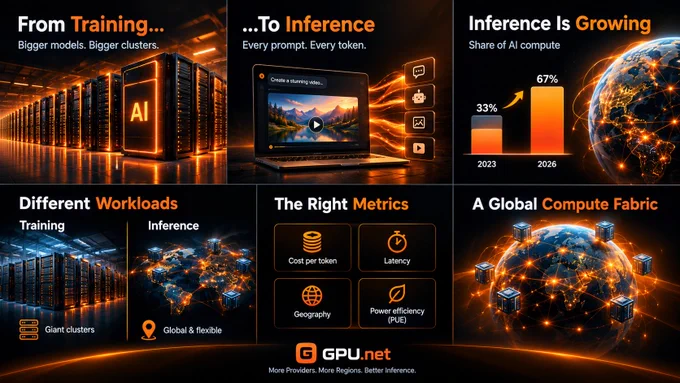
1/ Feels like we've spent the last two years obsessing over training. Bigger models. Bigger clusters. Bigger training runs. Meanwhile, the economics of AI are shifting somewhere else: Inference. 🧵 2/ Training gets the headlines. Inference gets the bill. Frontier-model training costs are measured in the hundreds of millions. But once a model is deployed, every prompt, every agent action, and every generated token becomes an ongoing expense. You train once. You serve forever. 3/ The data is moving fast. Inference represented roughly 1/3 of AI compute in 2023. Deloitte projects it will reach roughly 2/3 by 2026. That's a massive shift in just a few years. 4/ The mistake many teams make? Treating training and inference like they need the same infrastructure. Training wants giant centralized clusters. Inference often benefits from: • Lower latency • Regional deployment • Better cost efficiency • Proximity to users Different workload. Different priorities. 5/ For production AI, the key metrics aren't just FLOPS anymore. They're: • Cost per token • Latency • Geography • Power efficiency (PUE) That's where margins are won or lost. 6/ The challenge is that compute is fragmented across hundreds of providers and regions. That's where @gpunet comes in. Instead of manually researching infrastructure, teams can compare providers, discover available capacity, and find infrastructure that fits their inference workload. The future of AI won't run on a single cloud. It will run on a global compute fabric. #AI #GPU #DataCenters #InferenceAI