Since January 2026, Microsoft has observed Russian state threat actor Star Blizzard evolve their detection evasion capabilities through large-scale phishing campaigns, the use of accounts on compromised websites, and a novel malware delivery technique that Microsoft tracks as #RedFlick, a malware delivery technique used to deploy the actor’s custom backdoor, #CosmicPulse.
This blog provides updated technical analysis of Star Blizzard’s tactics, techniques, and procedures (TTPs) observed throughout 2026, building on our 2025 and 2023 blogs.
#MIRAGEmicrosoft.com/en-us/security…
🆕Principal Threat Intelligence Analyst
Just posted. I'm leading this search👋; full details & apply here: apply.careers.microsoft.com/…
Unique needs = unique opportunity (fully remote + active clearance)👀
Please read the posting, I spent time making it precise:
• on our team, you will obtain real-time visibility into hundreds of simultaneous intrusions and convert this into finished intelligence, prioritized judgments, and protection at scale
• the successful candidate is a critical thinker and problem solver, skilled at discovering novel intrusions and adversary tradecraft through analysis, and curious enough to pursue impact through product hardening and disruptions where there is no precedent
New AI SOC startup just* dropped: “incorporating predictive analytics and machine learning into the SOC workflow can help augment the productivity of analysts, free up time, and ensure they utilize investigative skills and creativity on the threats that truly require expertise”
*in 2018: cloud.google.com/blog/topics…
Russian threat actor Midnight Blizzard is conducting widespread traffic manipulation attacks at hotels worldwide. Result: delivering malware or redirecting auth flows at their discretion, globally.
Since early May 2026, we saw this subcluster manipulate DNS and HTTP traffic from networks served by captive portals to redirect user traffic through actor-controlled infrastructure. We’re calling the campaign CaptiveCrunch.
“We have observed notable commonalities in the equipment and management systems used across multiple affected networks.”
We break down the malware & techniques, but the most important part is how dynamic all of it is: Midnight Blizzard is using AI to support a significant portion of these operations. They are moving and changing quickly.
Feedback welcome on the suggested mitigations: microsoft.com/en-us/security…
Help spread the word to VIPs in governments, diplomatic entities, non-governmental organizations (NGOs) in the US and Europe (probably also those traveling to Black Hat)
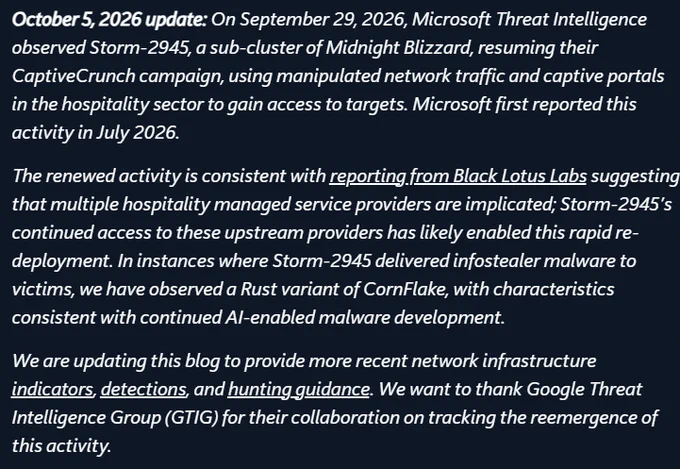
Storm-2945, a sub-cluster of the Russian state actor Midnight Blizzard, has resumed their CaptiveCrunch campaign. msft.it/6019aWMDf
First reported by Microsoft Threat Intelligence in July 2026, the campaign uses manipulated network traffic and captive portals in the hospitality sector to gain access to targets.
The renewed activity is consistent with reporting from Black Lotus Labs suggesting that multiple managed service providers are implicated; Storm-2945’s continued access to these upstream providers has likely enabled this rapid re-deployment.
We have updated our blog to provide more recent network infrastructure indicators, detections, and hunting guidance. We want to thank Google Threat Intelligence Group (GTIG) for their collaboration on tracking the reemergence of this activity.
Since January 2026, Microsoft has observed Russian state actor Star Blizzard evolve their detection evasion capabilities via large-scale phishing campaigns, the use of accounts on compromised websites, and a new malware delivery technique called RedFlick. msft.it/6010actya
RedFlick can enable CosmicPulse malware installation after a single user interaction, reducing friction in the compromise process. Combined with the actor’s updated tactics, techniques, and procedures (TTPs), these changes improve Star Blizzard’s ability to reach more targets and increase the likelihood of successful compromise
These developments reflect the actor’s continued efforts to streamline malware deployment and scale operations to support ongoing cyberespionage objectives. Get detections, indicators of compromise (IOCs), and hunting guidance from this Microsoft Threat Intelligence blog post.
MIT published a brutally honest report on what AI is doing to students.
A committee of professors and students spent five months studying how AI changed learning on campus, and the findings read like a warning to every university on the planet.
Study groups are disappearing. Office hours are emptying out. Problem sets and take-home exams no longer prove anything, because AI can produce credible solutions to almost any written assignment in the undergraduate curriculum. Students who lean on chatbots lose mastery and confidence, and some slip into what the report calls cognitive surrender, reaching for AI at the first hint of struggle.
The numbers are rough. 46 percent of surveyed MIT undergrads use LLMs daily. 90 percent worry about their own overreliance. Undergrads who feel AI makes them replaceable now outnumber those who feel it makes them capable.
The committee's answer surprised me. They refused to fight AI with surveillance. The report calls AI detectors unreliable, says lockdown browsers feel like spying, and warns that policing students builds a classroom atmosphere of mutual distrust.
Instead, MIT wants to rebuild education around the things AI can't replace. That means oral exams, semester portfolios, in-person project work, and a required social component in every subject. The report even floats the idea of rethinking grades entirely, since without a GPA to optimize, much of the incentive to cheat with AI evaporates.
The committee warns professors against replacing undergrad research assistants with AI agents just because they're cheaper, because a university exists to grow people, not output.
The most famous tech school on earth admitted the machines broke its way of teaching. Its answer is more humans, not more software.
"Important to remember that the field of AI, since its beginning, has been rife with often misleading anthropomorphic metaphors, terms like “thinking,” “learning,” “reasoning,” and “understanding” glibly applied to very un-human-like computer processing" aiguide.substack.com/p/misle…
On August 2, 2026, the financially motivated cybercriminal actor tracked by Microsoft Threat Intelligence as Storm-1175 began deploying a new ransomware strain called StormEncryptor.
Storm-1175’s deployment of StormEncryptor marks the threat actor’s first activity observed by Microsoft Threat Intelligence since April 2026, and a shift away from Medusa ransomware, which the threat actor had previously been known to use.
StormEncryptor is written in C++ and appends the file name extension .encrypted to files it encrypts. It then drops a ransom note named !!!README_FIRST!!!.txt to every scanned directory.
While Microsoft has not confirmed the vulnerability targeted by Storm-1175 in this campaign, the threat actor is likely exploiting the CVE-2026-18577 authentication bypass vulnerability in N-able, which was disclosed on August 2, 2026 and added to the Cybersecurity and Infrastructure Security Agency (CISA) Known Exploited Vulnerabilities (KEV) catalog on August 3, 2026.
Storm-1175 is known to operate high-velocity ransomware campaigns that weaponize N-days, taking advantage of the window between vulnerability disclosure and patch adoption. msft.it/6010a1njK
In this new activity, Storm-1175’s post-compromise behavior includes abuse of remote monitoring and management tools AnyDesk or SimpleHelp, Advanced IP Scanner for discovery, and LSASS dumping using Mimikatz.
This threat actor is known to rapidly move from initial access to data exfiltration and ransomware deployment, often within a few days. Organizations are urged to monitor for Storm-1175 activity and apply security patches as soon as possible.
Microsoft Defender Antivirus detects StormEncryptor (SHA-256: c19ded65e822bb43ad0381c58abf33b7c8890f7bcc7125058a0c849c7e1a6054) as Ransom:Win64/StormEncryptor. Microsoft Defender for Endpoint detects this activity through multiple alerts, including “Hands-on-keyboard attack involving multiple devices” and “Potential human-operated malicious activity”.