
Today we’re featured in @LaVanguardia talking about AI, data sovereignty, and why the EU is competing in one of the most important races of our time and how at @helmcode we’re working to help meet that challenge.

 Open web. Clear feed.

AI open models ready to use. Private inference with flat rate. Own your models with privacy, zero logs and EU compliance Community & builders at nan.builders
Today we’re featured in @LaVanguardia talking about AI, data sovereignty, and why the EU is competing in one of the most important races of our time and how at @helmcode we’re working to help meet that challenge.
🧑🍳 We are cooking the best report about open models. A data research about how the open-model ecosystem looks today, read from the most important sources in the field. - Most downloaded and used models - How closed are open to closed models? - Where are the tokens going? - Economics: cost per task - Who is using open models? - Who runs open models? Inference and hardware State of Models will be released on Tuesday 24th Nov 👀 Save the date! Data and research from @huggingface @Cloudflare @OpenRouter @OpenAlex_org @EpochAIResearch @ValsAI @ArtificialAnlys @tryramp @vercel @novita_labs @SemiAnalysis_ @helmcode and more
Full write-up on the new agent coordination architecture we tested with @agent_swarm DeepSeek + Clef + rules beat Opus 5.5 The whole experiment, the methodology and the full agent system architecture are all in there 👇 Next steps: more experiments

👀 DeepSeek just outperformed Claude Opus 5.5 in an AI agent coordination benchmark. We tested a different architecture with our friends at @agent__swarm, adding explicit rules and Clef, a decision model from @Cloudflare, to support agent coordination. The results? DeepSeek V4.1 Flash went from 83% to 100% success on evaluated runs. Claude Opus 5.5 scored 93%. The sample is still small, and the runs weren't identical, so there's more testing to do. But the result is promising: we may be able to improve agent performance by changing the architecture, without always needing a larger model. Huge credit to @voidisomorphism and @ecura for running the experiment. Next, we're expanding the tests to more software engineering tasks. We'll publish a technical article and video breaking down the architecture, methodology and results next days. Full benchmark 👇 api.desplega.agent-swarm.dev…

Not every AI task needs the smartest model available. Sometimes you just need to classify a ticket, extract a few fields or summarize a document. Using a frontier model for everything is a bit like hiring your most expensive engineer to rename files all day. We have an extensive guide to open models for every use case (more than 80) you can finde here: helmcode.com/open-model-guid…

🤔 How to reduce LLM and AI infrastructure costs without sacrificing quality We published a guide on cutting AI costs. There's an example in chapter 1 we keep coming back to. You run 10,000 tasks for $330 and 9,000 of them come out right, so each good result costs you about $0.037. Then you move to a cheaper setup: $280 for the same 10,000 tasks, but only 7,000 come out right. Each good result now costs $0.040. You pay less every month and every useful result costs you more. That's why the guide measures everything as cost per accepted task. To save, the first thing that help is splitting the bill by operation. It's 14 chapters guide, and each one can be read as a quick overview or in full detail. There's also a spreadsheet and a SQL query to build your own baseline. helmcode.com/guides/ai-cost-…

🤔 About AI Act: Spain's data protection authority (AEPD) just warned a company that planned to score CVs with AI. The tool wasn't even live yet. The case raises a question many teams building on third-party APIs haven't asked: when does your app make you a high-risk AI provider under the AI Act? You don't need to train a model for that. A system prompt like "score this CV from 1 to 10 and reject anything below 5" is enough to land in Annex III. Put that app into service under your name and you can be its provider. Rodrigo Cilla Ugarte walks through it, using the CV case as an example: → What the AEPD asked for: privacy by design, a DPIA, transparency and human oversight that can actually question the score → Why the CV travelling inside the prompt matters (photo, date of birth, career history) → The three cases in Article 25 → Why "summarise this CV" and "score it and reject below 5" can end up in very different places → Deadlines: Annex III obligations moved to 2 December 2027, but the GDPR and Spain's Royal Decree 723/2026 already apply Plus five things to check before you deploy something like this. Full article here: helmcode.com/posts/high-risk…


RESUMEN FINAL. Soy Monti he trabajado para startups durante 5 años y ahora quiero intentarlo con este proyecto y compartirlo desde una vision no solo de desarollo si no 360. Todos los agentes usan @helmcode y su sub de 70 de NaN.
When you send a request to an open model on Helmcode, it runs on infrastructure we operate in Europe. We don't forward it to whichever third-party provider happens to be cheapest that day. And we don't store your prompts. It's a fairly simple distinction, but one we think matters a lot when companies start building with real customer data. You should know who's running your AI.

Read it, or is the summary enough? I share a link and Runline decides: Jev (a small decision model) picks, Apple's on-device model summarizes only when needed. Fitting example: @helmcode's guide on cutting AI costs 👇 runline.juanpecatalan.com/bl…


DISCURSOS.xyz funciona gracias a @helmcode. Analizar las agendas de los grandes partidos, transcribir, procesar las intervenciones y analizar los mensajes es mucho más fácil gracias a ellos.

La idea es sencilla, DISCURSOS.xyz es un archivo público de las intervenciones de políticos desde que se anunció la convocatoria electoral del 29N. La palabra importa. Y por eso quiero que sirva de inspiración y de objeto de estudio. Que nos ayude hoy a desarrollar criterio propio, porque es más necesario que nunca. Si te interesa conocer qué dicen nuestros políticos y candidatos a las Elecciones Generales del 29 de Noviembre, aquí las tienes todas (o casi todas).

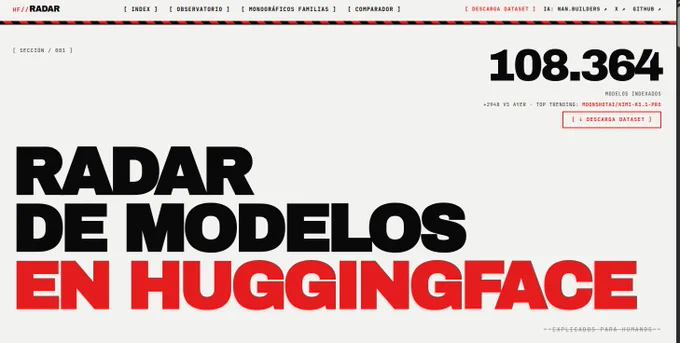
Se han superado los 100.000 análisis en el Radar y observatorio de modelos de IA en HugginFace. Podéis bajar la minería de datos en el repo : ) ¡Gracias! radar-huggingface.686f6c61.d…
One tweet can start a company. How far can we take it? 🚀 We're launching the Helmcode YouTube channel! And we're kicking things off with this incredible intro created by @Saulgmz_. Absolute cinema. 🚬 Sound on. 🔊 We want to hear what you want to see on the channel. We've prepared a nice form for getting your responses: nan.builders/prompt And if this is just the intro, imagine what's coming next. 😏 youtu.be/c7-QvNDoLvE

Un tweet puede crear una compañía. ¿Hasta dónde podemos llevarla?🚀 ¡Lanzamos nuestro canal de Youtube en @helmcode! Con esta intro al canal creada por @Saulgmz_ Absolute cinema 🚬 Activad el sonido. Quiero saber qué os parece. Si esta es la intro, esperaos a ver los vídeos 😏 youtu.be/c7-QvNDoLvE?si=gF9M…
This is how our inference architecture works at Helmcode. Serving inference in production is more than hitting the API you use. 🤷♂️ You need routing, fallbacks, observability, cost control, and the right deployment model. Here's a closer look at how we approach it at Helmcode: 1/ API Gateway & Routing Every request enters through an OpenAI-compatible API. We handle authentication, rate limits, and routing to the appropriate model and infrastructure. 2/ Model Serving Different models have different requirements. We run inference workloads across GPU infrastructure, managing model replicas, batching, and concurrency to balance throughput and latency. 3/ Scalability & Reliability Traffic isn't constant. The infrastructure needs to handle demand spikes, distribute requests across available capacity, and recover when something fails. 4/ Observability We monitor latency, token throughput, GPU utilization, errors, and request volume to understand how the system is performing and identify bottlenecks. 5/ Cost & Deployment Infrastructure decisions directly affect inference costs. Shared, dedicated, and on-prem deployments have different trade-offs in utilization, isolation, performance, and economics. All of this needs to work together while keeping the API simple for developers. This is how we make open model inference accessible to businesses at Helmcode.

El estudio de grabación que tiene la buena gente @getmanfred está chulísimo. Muchas gracias por la invitación! PD: en la comunidad ya somos +1K 🚀
🔥‼️ ¿Pivotar todo el modelo de negocio de tu empresa con un solo tuit? Hemos traído a Cristian Córdova (@barckcode), fundador de @helmcode, a charlar con nosotros sobre cómo pasaron de ser una empresa de servicios cloud tradicional a un proveedor de inferencia de IA en Europa🧵

