←
highscalability2,033 posts
highscalability avatar

highscalability

@highscal

Building bigger, faster, more reliable websites.

◷ Joined September 2009▧ 109 Photos and videos
Alex Xu avatar
⟳ highscalability retweeted
Alex Xu@alexxubyte·Sep 10

🚀 Announcing ByteByteGo Live: learn AI live from real builders. I’ve spent the past 8 years on education: thousands of hours writing books, deep dive newsletters, YouTube, etc. Two issues I keep seeing are: 1) it’s very different to learn from real builders. 2) most online courses never get finished (~4% completion). Over the past 12 months, we’ve been working on what we can do to change that. Today, I’m excited to announce ByteByteGo Live: live cohort courses taught by real builders. - Taught by real builders. Our instructors include very senior engineers from Google, Meta, etc., as well as @KentBeck , the creator of TDD. They teach what they use in their own work. - Live cohorts. Every course runs live with a group of people, and instructors answer your questions in real time. The current lineup: - AI Engineering Fundamentals - Build with Claude Code - Build Production Grade AI Systems - Rebuild YouTube with AI - AI Evals in Practice - AI Cost Optimization - Trust-optimized AI Development We have big plans for the year ahead: more courses, more instructors, and deeper hands on projects. Check out go.bytebytego.com/live-launc… and let us know what you think.

Post attachment
Alex Xu avatar
⟳ highscalability retweeted
Alex Xu@alexxubyte·Aug 21

12 most-starred skill repos on GitHub as of August 2026. What's your favorite?

Post attachment
Alex Xu avatar
⟳ highscalability retweeted
Alex Xu@alexxubyte·Aug 19

What is MCP Really About clearly explained in 5 minutes

5:03
highscalability avatar
highscalability@highscal·Jul 29

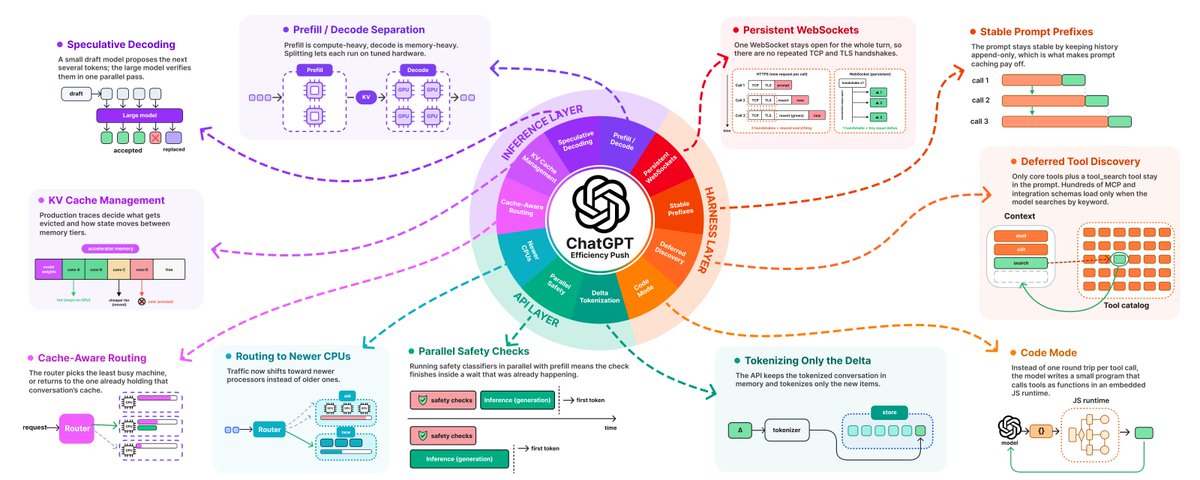
Great read if you are interested in how ChatGPT Optimizes its Harness, API, and Inference

Bytebytego @bytebytego Jul 29 Article How ChatGPT Optimizes its Agent Loop: Harness, API, and Inference AI labs are moving faster than ever and releasing the most capable models we have ever seen. Just recently, Anthropic released Fable 5, then OpenAI released the GPT-5.6 family, including GPT-5.6 Sol,

Alex Xu avatar
⟳ highscalability retweeted
Alex Xu@alexxubyte·Jul 27

NVIDIA's Open Models in 1 Diagram You probably know NVIDIA as the company that sells GPUs. But it’s also the world’s largest publisher of open AI models (@NVIDIAAI), with a lineup that goes far beyond chatbots. We wanted to understand how a company best known for hardware builds so many high quality models, and why it gives them away for free. So we spoke with @ctnzr, VP of Applied Deep Learning Research at NVIDIA. He walked us through the full lineup and the ideas behind it, summarized in the diagram below. 1. Reasoning: Nemotron is NVIDIA's family of LLMs that think before they answer. The line started in 2023 and the current generation, Nemotron 3, is a hybrid + MoE model that comes in three sizes: Nano for fast simple tasks, Super for harder planning, and Ultra for the heaviest reasoning. 2. World models: Cosmos predicts the next state of the physical world, not the next word. Cosmos 3 is one omni-model that can generate plausible video of a scene, reason about what is happening, and predict what comes next. 3. Robotics: Isaac GROOT is the first open humanoid foundation model. GROOT 1.7 takes camera frames and an instruction in, and outputs motor commands in real time. Its reasoning core is Cosmos Reason. 4. Production: safety, speech, and vision models. These are the building blocks that make AI usable in real applications. 5. Specialized domains: BioNeMo for biology and drug discovery, Alpamayo for self-driving cars that explain each decision, NVIDIA Ising for quantum computing, and Earth-2 for weather and climate modeling. Read the full breakdown here: blog.bytebytego.com/p/how-nv…

Post attachment
Alex Xu avatar
⟳ highscalability retweeted
Alex Xu@alexxubyte·Mar 30

All 7 ByteByteGo ebooks, FREE for a limited time. Link at the end. - System Design Interview Vol. 1 - System Design Interview Vol. 2 - Machine Learning System Design Interview - Coding Interview Patterns - Object-Oriented Design Interview - Generative AI System Design Interview - Mobile System Design Interview Whether you’re preparing for interviews or looking to deepen your architecture knowledge, this is a great opportunity. Offer ends May 1. Please help spread the word. Check it out now at: bytebytego.com

Post attachment
Alex Xu avatar
⟳ highscalability retweeted
Alex Xu@alexxubyte·Jan 27

Cursor recently shipped Composer, its agentic coding model, and shared that the agent can be ~4× faster! We worked with the Cursor team, particularly @leerob, to understand how the system is put together, and what drives the speed. A coding agent is a system that can take a task, explore a repo, edit multiple files, and iterate until the build and tests pass. Inside Cursor, a router first picks a suitable coding model (including Composer) to handle the request. The system then starts a loop: retrieve the most relevant code (context retrieval), use tools to open and edit files, and run commands in a sandbox. Once the tests pass, the task is complete. Cursor uses three key techniques to keep this loop fast: 1. Mixture-of-Expert (MoE): A sparse MoE architecture activates only a subset of model weights per token. 2. Speculative decoding: a smaller model drafts multiple tokens at once, then a larger model verifies them in parallel to reduce latency. 3. Context compaction: summarize older steps and keep only the active working set so the prompt stays relevant and short as iterations continue. Full newsletter here: blog.bytebytego.com/p/how-cu…

Post attachment
Alex Xu avatar
⟳ highscalability retweeted
Alex Xu@alexxubyte·28 Nov 2025

⏳ LIMITED TIME OFFER: All in One Interview Prep Black Friday Sale Yearly Black Friday sale is now live! Use code BF2025 at checkout to get 30% off the all-in-one interview prep online courses. To take advantage of this limited time offer, subscribe before 11:59 pm PST on Monday, December 1. Get it here: bytebytego.com

Post attachment
Alex Xu avatar
⟳ highscalability retweeted
Alex Xu@alexxubyte·11 Jun 2025

Shopify handles scale that would break most systems. On a single day (Black Friday 2024), the platform processed 173 billion requests, peaked at 284 million requests per minute, and pushed 12 terabytes of traffic every minute through its edge. These numbers aren’t anomalies. They’re sustained targets that Shopify strives to meet. Behind this scale is a stack that looks deceptively simple from the outside: Ruby on Rails, React, MySQL, and Kafka. But that simplicity hides sharp architectural decisions, years of refactoring, and thousands of deliberate trade-offs. In this newsletter, we map the tech stack powering Shopify from: - the modular monolith that still runs the business, - to the pods that isolate failure domains, - to the deployment pipelines that ship hundreds of changes a day. - It covers the tools, programming languages, and patterns Shopify uses to stay fast, resilient, and developer-friendly at incredible scale. A huge thank you to Shopify’s world-class engineering team (@ShopifyEng ) for sharing their insights and for collaborating with us on this deep technical exploration. 🔗 Dive into the full newsletter link below 👇

Post attachment
Alex Xu avatar
⟳ highscalability retweeted
Alex Xu@alexxubyte·7 Jan 2025

𝐁𝐈𝐆 𝐚𝐧𝐧𝐨𝐮𝐧𝐜𝐞𝐦𝐞𝐧𝐭: we’ve launched a new YouTube channel! – 𝐂𝐨𝐝𝐢𝐧𝐠 𝐏𝐚𝐭𝐭𝐞𝐫𝐧𝐬 The first video is already live, and we'll aim to post new videos fortnightly. This channel will be run by my colleague Shaun Gunawardane. Our goal is to provide high-quality, entertaining explanations on coding patterns, and interview tips, without making you feel like you’re stuck in a boring lecture. Whether you’re prepping for a big coding interview, sharpening your problem-solving skills, or just looking for something fun to watch during your lunch break, this channel has you covered. Here's a sneak peak into some titles you might see in the future: - When BFS beats DFS - The dangers of Big O analysis - Dynamic programming for people who hate it - Why you should always bring up space complexity - Never ignore problem constraints - Why you never remember coding solutions - Something you should say in every interview - The pitfalls of recursion - Hash maps changed everything - The algorithm used to detect cancer Subscribe here: youtube.com/@coding-patterns… #systemdesign #coding #interviewtips .

Post attachment
Alex Xu avatar
⟳ highscalability retweeted
Alex Xu@alexxubyte·1 Jan 2025

How many API architecture styles do you know?

Post attachment
Alex Xu avatar
⟳ highscalability retweeted
Alex Xu@alexxubyte·11 Dec 2024

Our Coding Interview Patterns book has become a bestseller in the Algorithms and Data Structures category! Thank you all for reading it!

Post attachment
Alex Xu avatar
⟳ highscalability retweeted
Alex Xu@alexxubyte·4 Dec 2024

My new book, Coding Interview Patterns, is now available on Amazon! I’ve been working on this book for 1.5 years with my co-author, Shaun Gunawardane. Our goal is to help you understand the underlying patterns of each coding problem, so you don’t have to grind through 100s/1000s of them. We’ve also included 1,000+ diagrams to help you quickly grasp the reasoning and logic behind a solution within 5–10 minutes. I hope this book achieves its goal.

Post attachment
Alex Xu avatar
⟳ highscalability retweeted
Alex Xu@alexxubyte·29 Nov 2024

🔥 Black Friday Special – 30% OFF on All ByteByteGo Products!

Post attachment