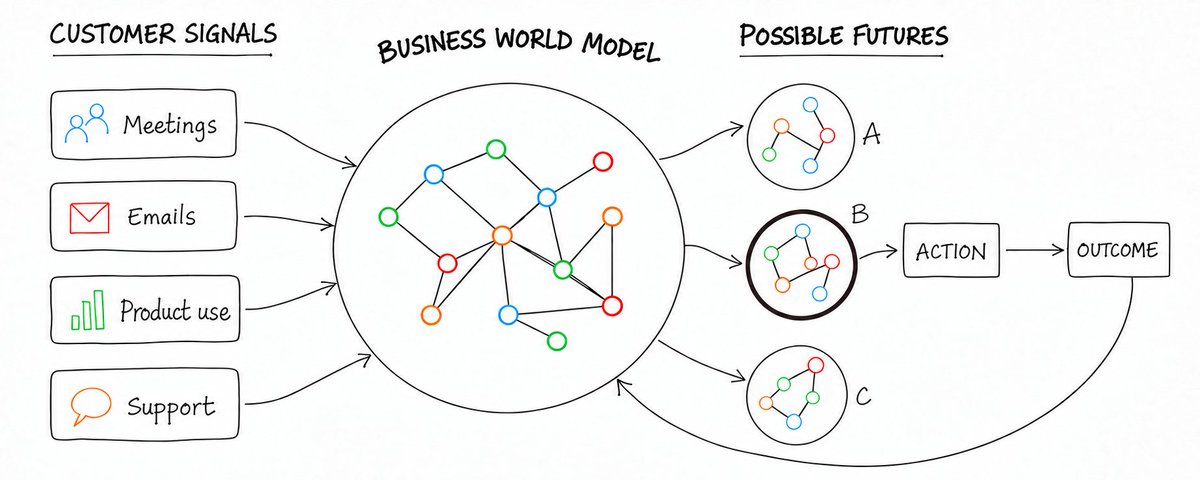
Yesterday we announced our series A to reimagine CRM as a business world model.
I wanted explain what we mean by that, and why the CRM is the practical place to start building something much larger.
What does it look like to migrate your sales team to Lightfield? We documented our playbook for getting your data model configured, records migrated, and team trained within your first 30 days on the platform.
lightfield.com/blog/how-we-m…
Intent HQ builds customer intelligence products for telecom, retail, and financial-services companies. After moving their sales org to Lightfield, the team runs pipeline reviews, forecasting, deal prioritization, and coaching from a business world model that updates itself after every interaction.
Before the switch, CEO Jonathan Lakin said the only way to know what was really happening in a deal was to ask the salesperson.
Now, when a deal slows down, he and his sales leaders open the account in Lightfield and point to the conversation that raised the concern, so the review starts from what the customer said.
Read more about how Intent HQ manages pipeline review and forecasting in our latest case study: lightfield.com/customers/int…
Intent HQ prides themselves on adopting new technology early. They decided to roll out Lightfield across a global team of over 150 people right after we came out of stealth, when we had far fewer features than their previous CRM.
They understood then what more companies are starting to see now: the context your CRM has about your business matters more than any single feature.
Intent HQ has a team building agents across the business, and those agents pull customer and revenue context from Lightfield. Jonathan Lakin, their CEO, is training one of them to work as a digital chief of staff, and it checks customer requests against Intent HQ’s own product documentation and codebase to work out how they could serve those customers better. Their agents query how long each deal has sat in each stage, along with what was said in the conversations behind it, so they can see which deals are moving and why the others have stalled.
We have a lot more features today than we did in January. I still think context is the most important thing a CRM holds, because it’s what every agent at your company will work from.
I’m grateful to the Intent HQ team for giving us a chance so early in our journey.
Recently we shipped WhatsApp sync in Lightfield.
Quite a few Lightfield customers talk to their customers over WhatsApp. This gets more common the further you sell from SF, especially to established companies and anyone working across countries. Selling happens in chat threads rather than calls or emails.
We also recognize it’ll be hard to know the messages we’re syncing from WhatsApp are all with customers and about sales. So to solve that we’ve made it easy to approve the association of WhatsApp message activity to a given contact record so it’s always opt-in.
We built Lightfield’s data model to capture the nuances of how a business works — not just its core entities, but the relationships, events, and concepts that have meaning to that company.
Most CRMs support custom data modeling, but in practice few teams put it to use. That's because making and maintaining these changes becomes an administrative project. Power is a great case for the value of making this easier.
Power helps patients find and enroll in clinical trials, working with pharma and biotech sponsors and research sites. A site can be both a delivery partner and a customer, while a sponsor can run several trials with separate buying decisions. Representing that business requires capturing those relationships and the context in which they apply, beyond labeling a company as a “customer.”
A few months ago, @brandonhli and I were testing an automation that scans ClinicalTrials.gov for new trials that Power could help recruit patients for. The test run surfaced a Phase 2 Alzheimer’s trial that had received FDA IND acceptance 13 hours earlier.
Lightfield interpreted this alert with the context of Power’s business: which sponsors were customers, which trials they ran, and the conversations Power had already had with them. That context helped Lightfield move from identifying a potentially relevant trial to recommending a clear next step.
Every company has distinctions like these that influence how it operates. A data model that captures them gives an agent a more accurate understanding of the business and a better basis for interpreting new information. We think that is an important foundation for an agent to help a team understand what is happening in its business and decide what to do next.
October was a big month for @lightfld and an even bigger month for our customers.
@general_compute raised $100M to build a cloud that runs AI models fast, on chips beyond Nvidia’s.
@fragmentdata raised $56M to build agents that fix the purchasing and payment problems that slow down big companies.
@Albert_Invent raised $55M to help chemists design better experiments with AI.
Many of our customers come to us when the tools they bought as an early-stage start-up prevent them from scaling beyond founder-led sales.
These companies, and many others like them, are closing deals faster and building more pipeline by using our platform to construct a world model of their business. Anyone can query it to make better decisions about how to grow their business. A CRO can see which objections keep costing the team deals. A product leader can see which features prospects ask for most. A new AE can ask which messaging has landed best when preparing for a call.
I’m proud of what our customers have accomplished and how we’ve been able to support their growth. We’re just getting started.
Lightfield's plugin for @ChatGPT and Codex is now live.
Ask any question about your company or customers, and get answers grounded in a world model of your business.
Install it in ChatGPT: chatgpt.com/plugins/plugin_a…
Your transcripts and notes will be auto-associated with any contact, account, or opportunity records in your CRM.
We're working to improve support for more of the ways you capture conversations with customers. More to come!
Details: support.lightfield.app/artic…
Long time coming: you can now sync your individual + team Granola meetings directly to Lightfield with the Granola API.
Transcripts and notes will match to meetings in Lightfield automatically using your linked calendar.
We've been cooking up scaled use of decision models for classifying external comms you sync to your crm.
Also teaching our automation engineer how to build you automations that use these models.
Jev matches frontier models on classification at a fraction of the cost. The obvious follow-up: can an agent build and maintain classifiers?
I tested on six tasks. Opus built classifiers matched or beat fine-tuned RoBERTa on all six.
Everyone has been impressed by TypeSafe AI’s Jev — I wanted to see for myself how good it is — and how useful it could be for a product like @lightfld.
I started with text understanding, because it is the foundation of everything a decision model does: it has to understand the input, and it has to understand and follow the instructions you give it.
The short takeaway: TypeSafe's tiny "Jev" classifier is surprisingly good — roughly on the level of Claude Sonnet on classification tasks, while being a couple of orders of magnitude cheaper to run.
I looked at two kinds of work. First, general text understanding: three widely used reading-comprehension and commonsense benchmarks, where Jev performed on par with Opus. Because those may well sit in Jev's training data, I also hand-authored a fresh benchmark over a single random Wikipedia article — every wrong option drawn from the text, so nothing could be memorized. There, Jev landed alongside Sonnet and Opus (it tops CommonsenseQA and MMLU-CF, ties Opus on RACE-H, and is ~150× cheaper and ~10× faster on long-context questions).
Then I tried tasks closer to sales and customer relationships. There aren't many good public benchmarks, so I dug up older customer-service and negotiation datasets. On those, Jev is a bit better than Claude Haiku and slightly below Sonnet 5. Big caveat: none of these come from real B2B sales, so the findings are directional rather than a description of what we actually do at @lightfld .
Overall, the results look good enough that I think small, inexpensive classification models like Jev will have real uses, including in our own product.
Link to the full write-up below.
Ali Ghodsi: “There’s no agentic work that’s automated the whole enterprise. That has just not happened.”
“I think that the real reason, if you actually look at it, is the models are smart enough, but they just don’t have the context that exists inside of any organization.”
“We don’t need a smarter model that can actually solve Navier-Stokes or conjectures or do better on Humanity’s Last Exam. We need it to just go from 60 to 70%.”
Co-sign. We’re very early on getting the most out of context.
Brilliant conversation @alighodsi@martin_casado
Databricks' @alighodsi on AI risk and adoption:
Ali isn't losing sleep over the existential risk debate.
He says a number of conditions would all have to be true simultaneously to enable an actual runaway takeoff scenario, and currently several opposite conditions exist.
Each frontier training run requires significantly more resources. Power, GPUs, engineers - and some attempts fail, burning up huge piles of money with them. Until that reverses, he doesn't see the self-improving loop happening.
Cyber is what he's watching most closely and where he anticipates real impact. Most orgs are not equipped for the coming change in agentic capabilities. The time between a vulnerability being published and being weaponized has collapsed from years to hours.
On adoption, he believes most companies don't need a smarter model. The models are already smart enough. The gap is context they don't absorb - the things an employee who's worked at a company for five years learned by osmosis.
If the frontier stopped advancing today, he thinks it wouldn't meaningfully change the value most are extracting from AI anyway.
In conversation with a16z's Martin Casado and Sarah Wang:
00:00 Intro
00:48 Why Ali places the AI risk near zero
05:05 The word "pacing" was a mistake
10:50 What 10k agents and $100m can do
12:20 What would change his mind on AI risk
14:20 More GPUs, more ways to fail
18:05 US export controls on PlayStations
20:10 The damage everyone expected by now
24:30 Public vulnerabilities weaponized in hours
30:15 Why labs can't grade each other
37:15 Why most of RSI isn't actually RSI
40:05 Why nobody really needs a smarter model
41:50 The AI use cases nobody argues about
47:30 Google Search solved this 25 years ago
50:55 Nobody has privileged knowledge now
55:10 Same model, new harness, 2x cost
58:15 Open source: 5% of spend, 60% of tokens
1:05:30 90% of new databases are created by agents
YouTube: youtu.be/GzEtpAKYRvE@databricks@martin_casado@sarahdingwang
After seeing the success of Tome, I was surprised to see @keithpeiris and @hliriani sunset the product.
They had 25 million users...why were the pivoting to such a boring vertical?
Only after going deep into the history of CRMs and understanding @lightfld's architecture did I realize that legacy sales tooling could not be retrofitted to make the most of frontier intelligence.
In order to be truly AI native, you have to rebuild the system around customer context from scratch.
Going forward, the smartest thing a founder can do is give high agency employees access to a world model of their business: a real time representation of their customers, how those relationships developed, and where they might go next.
In doing so, founders can effectively use frontier intelligence to better understand potential outcomes and create a culture where the whole company is learning from its users.
The teams that win will be the ones that move past customer categorization and learn how to weave together every customer touchpoint into evolving stories that help shape what they build next.
YB @yb_effect Sep 16 Article The best founders are world builders Startups fork reality. They construct a new world where their vision is tangible and then work relentlessly to bring others into it. As more users enter, their behavior and interactions reveal how the