
I'm entirely self taught all kinds of smart people told me not to learn to code (I'd "waste my time" and "at best become a mediocre engineer") good thing I didn't listen nor should you. follow your curiosity.

 Open web. Clear feed.

serial founder, exits to @coinbase @f5
I'm entirely self taught all kinds of smart people told me not to learn to code (I'd "waste my time" and "at best become a mediocre engineer") good thing I didn't listen nor should you. follow your curiosity.
Compute trading will be huge. Stoked to support one of the best teams going at it. Check them out!
Announcing @ComputeDesk raised $45M, led by @lightspeedvp, to solve compute risk. I left Meta last year to build a team of quants and GPU infrastructure engineers to build the clearing infrastructure for compute.

Today, we're introducing @discoveredmat . We build AI scientists that discover new materials for semiconductor chips. We’re starting by releasing our work - hundreds of new materials discovered using frontier AI models, along with our benchmark for tracking progress in this domain, Material Discovery Bench. To pursue our mission, we have raised $9 million from @LightspeedIndia (lead investor) , @ycombinator , @peakxvpartners , @paulg , @gokulr , @trq212 and many others. 🧵

i think every founder suffers from same disease "the overoptimistic underestimating brain" i have never yet in my founder journey woken up and thought "oh wow that took less than I thought and was as easy as I thought" it's always: "we planned too much, we can do 1/10th maybe if we get lucky and really try" which is why focus is so important radical focus means you choose the 1/10th that actually matters so stay focused
Duopolies are everywhere, not just crypto Apple (nice but closed) - Android (open but less ncie) Windows (functional but sucks) - Mac (designery but eg cant play games) Solana (fast, trades off decentralization) - Eth (decentralized but slow) This makes sense because you can take any product category and draw a line of preferences from A to B, and duopolies occupy the extremes
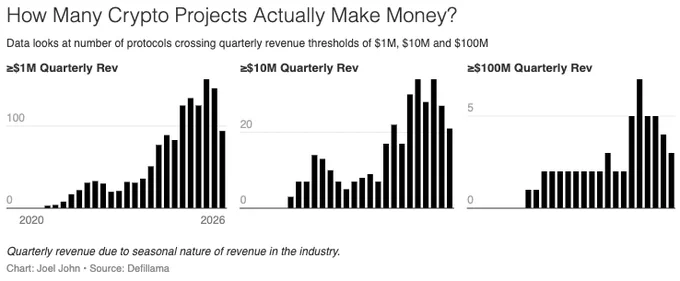
We have been crunching numbers around revenue and valuations within the industry. Last day, I shipped a long-form observing how and where crypto generates its revenue. Here are four charts that explain the state of the industry. 1. Crypto is indeed a game of extreme power laws Since 2020, crypto has generated ±$74.8B in verifiable revenue. This is a mix of t-bills income, trading fees and protocol revenue. The vast majority of it in the past year, came through stablecoins. Circle and tether account for ±98% of all stablecoin revenue. $0.34 of every dollar made (from defillama's data set) goes to a stablecoin firm. It is fairly apparent that there is latent demand for on-chain dollars and that is why we see an entire economy of VCs and founders flocking to the payments and fintech angle for blockchains. I am not entirely sold on what down-stream monetisation for neobanks look like, esp with Meta coming into the stablecoins game, but there is demand is what is apparent. The 18 months between Jan of 2024 and June of 2025, saw half of all crypto revenue being generated. We were in an upward trajectory for revenue for a good while before the temporary cooling that has come in the past few quarters. 2. Duopolies are the norm The lack of latent competition in multiple sectors have made an industry of duopolies. Across the top 15 sectors, combining the top two in terms of revenue, would quickly reveal that close to 80% of most revenue generating sectors are taken up by two firms. We may not see more competition unless there are two factors playing - more venture enables small, nimble teams to pursue large opportunities (like telegram bots) without tokens - tokenised ventures bring fresh energy to established sectors and pursue latent leaders (like in perpetual dex) Most founders presume there is no competition, when entrenched leaders are eating up $0.8 of every dollar produced. The long-tail is a scary place to be at. 3. More firms generate revenue than ever before There are close to 100 protocols/projects making over $1million in revenue. Many of these are small, nimble teams making trading interfaces or bots. Some of them are protocols that coordinate capital. It now takes shorter spurts of time to hit $1mil in revenue than ever before. Part of the reason is the underlying stack evolving. Players like Solana, Privy and the network of on-ramps for stables make it considerably easier for founders to build, distribute and develop applications. The surface area for what small, mimble, privately held projects can do through retaining bulk of the revenue is barely explored. I have a hunch sectors like prediction markets will continue to help teams turn profitable faster. Which tbf puts the role of a crypto VC into question. What do you do when teams don't need your capital? I have views, but perhaps best shared later. 4. Decentralised Exchanges are considerably discounted compared to L1/L2 If you study the numbers, it quickly becomes apparent that there are DeFi primitives that do more in economic activity than most L2s but are considerably discounted. I think the market will reprice this entirely. There is a lot more bloodbath in L2-land. There is a lot of repricing to be had in DeFi. With institutional capital entering the arena, there are good grounds for financial primitives to be valued higher. Most teams do not get an "integrity' premium but I have a hunch that this part of the cycle is where teams that were building since 2021, with treasury managed well begin dominating over random L2s that were grossly overvalued. Two key reasons for that. L2s were overvalued to begin with due to excess dry powder in '23/24 flowing towards them. In the two years since, many of them have sub $100 in daily revenue. Eventually markets will price that more aggressively. Whole piece linked below if you'd like to follow the money



The biggest blocker to your dreams is yourself Keep re-discovering this every year
The guy who wakes up at 10am and goes straight to his laptop Will go further than the guy who wakes up at 6am, journals, meditates, and does everything except the actual WORK Don't get caught in the self improvement trap without actually moving the needle
One of the coolest companies in current batch Check them out!
Origami Robotics is building high-DOF robotic hands with in-joint motors and a co-designed data-collection glove to eliminate the embodiment gap by collecting high-quality, real-world data at scale. Congrats on the launch, @DanielXieee and @QuanliangX! ycombinator.com/launches/Pcl…
calling it: within 12mo @karpathy will QT this and say "it now works, agents actually optimize the NN to perfection"
I had the same thought so I've been playing with it in nanochat. E.g. here's 8 agents (4 claude, 4 codex), with 1 GPU each running nanochat experiments (trying to delete logit softcap without regression). The TLDR is that it doesn't work and it's a mess... but it's still very pretty to look at :) I tried a few setups: 8 independent solo researchers, 1 chief scientist giving work to 8 junior researchers, etc. Each research program is a git branch, each scientist forks it into a feature branch, git worktrees for isolation, simple files for comms, skip Docker/VMs for simplicity atm (I find that instructions are enough to prevent interference). Research org runs in tmux window grids of interactive sessions (like Teams) so that it's pretty to look at, see their individual work, and "take over" if needed, i.e. no -p. But ok the reason it doesn't work so far is that the agents' ideas are just pretty bad out of the box, even at highest intelligence. They don't think carefully though experiment design, they run a bit non-sensical variations, they don't create strong baselines and ablate things properly, they don't carefully control for runtime or flops. (just as an example, an agent yesterday "discovered" that increasing the hidden size of the network improves the validation loss, which is a totally spurious result given that a bigger network will have a lower validation loss in the infinite data regime, but then it also trains for a lot longer, it's not clear why I had to come in to point that out). They are very good at implementing any given well-scoped and described idea but they don't creatively generate them. But the goal is that you are now programming an organization (e.g. a "research org") and its individual agents, so the "source code" is the collection of prompts, skills, tools, etc. and processes that make it up. E.g. a daily standup in the morning is now part of the "org code". And optimizing nanochat pretraining is just one of the many tasks (almost like an eval). Then - given an arbitrary task, how quickly does your research org generate progress on it?


