
The overall rate of change of a function from f from x=a to x=b is given by: [f(b)-f(a)]/[b-a] This is usually called the "average rate of change." Umm. The average of what exactly?
 Open web. Clear feed.
An Aussie fellow promoting uplifting joyful genuine math thinking and doing for students & teachers alike. Thrilled: globalmathproject.org reaching millions!
The overall rate of change of a function from f from x=a to x=b is given by: [f(b)-f(a)]/[b-a] This is usually called the "average rate of change." Umm. The average of what exactly?
A rectangle is subdivided into 4 rectangular regions. The numbers A, B, C, D can be their areas only if AD = BC. What is the analogous result for a rectangular box subdivided into 8 sub-boxes and their volumes?

Can these numbers be the areas of the rectangular subdivisions of the large rectangle?

A little rant ... I don't know what the word "simplify" means without context. E.g. "Simplify √20." Looks fine to me! All depends on what you want to do next with it. a) Between which two integers does √20 lie? b) Is the picture below of squares of areas 5, 20, and 40 realistic?

In how many, essentially different ways, can one shade the cells of a square?

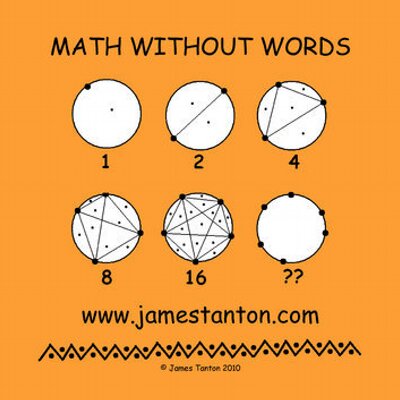
Still having fun sharing wordless puzzles. (From Tarquin's WITHOUT WORDS.)

Having fun sharing wordless puzzles. (From Tarquin's WITHOUT WORDS.)

What a spectacular message: vimeo.com/1242555304/ff2bfd9… Proud to have @drrajshah as a colleague and friend.

Here's a clock face designed by Paolo Uccello in the Florence Cathedral, dated 1443. Name some unexpected things you see.

I measured the location of the shadow of a stick each hour for an entire day. Any comments about the result you see?

Return to a favourite: Here's the clock of the Ferry building in San Francisco. Look at it closely. What do you notice that is unexpected about the clock face? The majority of clocks with Roman numerals exhibit this oddity. What is the historical origin of it?


