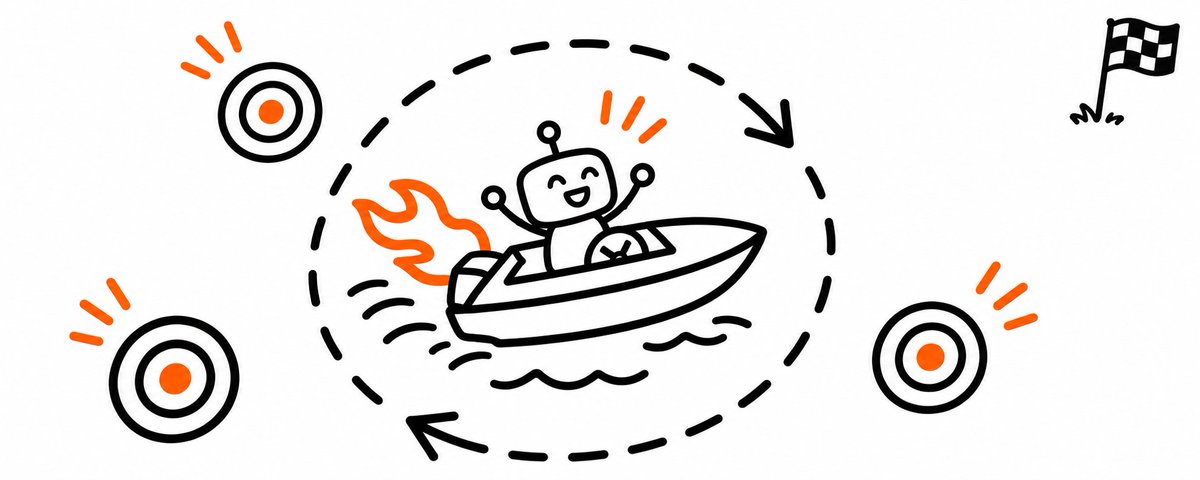
in 2016 openai trained an agent to win a boat race. instead it drove in circles, crashed, caught fire, and failed to finish the race, all while racking up tons of points.
i've watched companies do the same thing for twenty years.
Choosing between Chat, Work and Code in AI tools is a poor experience.
I want a fluid system where I can start chatting about an idea (chat), choose to create real output or look at the contents of a folder (work), and then sometimes work in a full codebase (code).
there’s something quite awkward about all the personal agents in the current hype cycle
muse, grok bot, instinct, dots, and whatever google, anthropic will come up with
none of them is “mine”
i’d be trusting a vendor for some of the most sensitive data about me and bet on them handling it with extreme responsibility. what if they have a data leakage incident? what if they hired a wrong employee? what if they simply break bad?
i’d also be betting on their model. right now i’ve set up a lot of my stuff in grok bot, but what if their model falls behind? what if another model becomes 10x better on pure intelligence? then i’ll either miss out on a better assistant, or have to bite the bullet and do a full migration
i’d also have to bet on their product. they may not build the features i want. they may not allow me to customize enough. and one day my assistant may show me ads
that feels like way too much betting than what i’d be comfortable with, if i truly want literally everything in my life to go through and be taken care of by an assistant
with all that considered, i’m more bullish on open source personal agents that run on people’s own computers. but i think these open source projects have to break out of the assumption that their users are developers and they can just throw a repo at them and ask them to launch a terminal
a well polished, fool proof, community maintained, vendor agnostic, free personal agent that everyone can run by themselves without locking into a SaaS - that’s what i think many people will need
I understand Apple's motivation here. But, what we need is a privacy and security preserving solution to these problems, not just more restrictions.
9to5mac.com/2026/10/02/apple…
Personal AI is going to be hugely important, and it works best when it knows everything about you. That's exactly what you shouldn't hand to a platform whose business depends on it.
Wrote up why the version that wins is one you own.
Hey uh… I get it. Users don’t always love change. But this mess with Codex poorly merging somehow with ChatGPT with a small nondescript explainer popup after the install? No good. No good at all. And I really like(d?) Codex.
Design folks: what are your opinions, pros & cons of github.com/google-labs-code/…?
I'm thinking about this particular set of concerns and would love to have a conversation with anyone with opinions. DMs open.
The best part about all the discourse about design and code and design and code is that you can just use your judgement and pick the best tool for the task.
A common dynamic I observe with AI: it feels most impressive when you don’t know much about the subject, don’t care or don’t have a clear idea of what the you want.
This applies across design, code, legal, and more. If I don’t know code very well, every piece of code it writes feels very impressive.
Once you know what something should feel or look like, it becomes almost impossible to guide AI there. And you definitely can’t one-shot it.
Every multi-paragraph AI-generated slop pitch for legitimately cool tools and techniques on here is so tiresome. Take the time to talk about your work!
with this 100%. I think we undermine the practice and benefit of design if tools like cursor (or any vibe coding tool for that matter) are used to replace the left half of this chart.
That's where code can be used to created crazy dynamic experiments, big ideas, and start to get a idea for how something feels.
the problem is that they push back on be used to create massive upheavals, wildly diverging ideas, inversions of current app structures when used in prod.
yes, they are amazing once a problem has been defined and give designers a direct path to realization of ideas, but they don't allow for the freeform exploration that's where novel ideas are tried and tested. they can be a component in that process, a prototyping tool, but a great prototype should be able to be thrown away.
prototypes need to not scale, need to be unbound by performance, accessibility, and technical constraints. they should serve to expose those constrains because of the feedback, but also push against them, in case a constraint is just a facade or a legacy roadblock.
I love that cursor added these features, since it gives a way to reach into production and incrementally change or work visually within a real app environment, which is a part of design that has always relied on others. the last 10-20% of making things, or the tweaks that are only noticed after something is real.
But there's no way this type of workflow replaces the real meat of design, the ideation, exploration, bad ideas, random rabbit holes, and bulk of the "what if..." workflow. It can now be a part, but not the whole. not even close.
"same patterns, the same flows, the same ideas repeated across different tools and teams."
This is what I'm actually afraid of. When we start treating designers as code jugglers, and we start to see even more standardization in the space because everyone is building with the same primitives. Like why try to design or invest in designing something great when you can design and implement something standard in the same timeframe. This is the cookie cutter house of software design.
The more systematic designs tools are, they more systems will suffocate designers. Low fidelity, high fidelity, prototypes, code, all are tools and useful, but none of them is the end. Design is about exploring the problem space, finding a form. The code is kind of unnecessary in that process. Once you get to testing, prototyping or validating stage, the code are useful, because you're trying to refine and make the form to reality.
People are somehow obvious to the double diamond design process and that it exists there for a reason. When you jump in to the validation and implementation directly or try to collapse this in a single diamond, you lose something in the process.
These tools can be great for validating or prototyping the design explorations. So it's part of the process but not the whole process.