
🚀Get ready for LooPIN mainnet launch! We're rolling out $LOOPIN on both - Solana (for GPU transactions) and - Ethereum (for trading).
 Open web. Clear feed.

PinFi for AI Computing docs: docs.loopin.network/ Discord: discord.gg/loopin
🚀Get ready for LooPIN mainnet launch! We're rolling out $LOOPIN on both - Solana (for GPU transactions) and - Ethereum (for trading).
Your PC is not a compute cluster. It is a stranded asset with a scheduling problem. In many workloads, DRAM is used only about 5% of the time. The rest is idle capacity, paid for upfront and trapped behind local demand. Centralized cloud scheduling can raise memory and GPU utilization, but concentration creates queues, opaque pricing, and regional shortages. Pooling works, but centralization controls access. One RTX 3090 can run DeepSeek at roughly 41 tokens per second. That is practical inference, not a lab demo. Millions of similar GPUs remain underused across homes, offices, labs, and small operators. The bottleneck is coordination, not silicon. Centralized AI optimizes fleet control. Decentralized AI optimizes market clearance. Dynamic pricing routes jobs to idle supply, enables affordable GPU renting. One-click deployment turns fragmented hardware into a global, miner-friendly pool. From personal PC to global compute pool, the advantage is open, programmable access. $LooPIN

AI compute is no longer just infrastructure. It is becoming a financial market. A new on-chain index tracks rental prices across five NVIDIA GPU classes. Related GPU price contracts support up to 10x leverage. Compute now has spot pricing, derivatives, and price discovery. GPU capacity is becoming an investable asset. The centralized model is a bottleneck: hyperscalers control supply, pricing is opaque, access is rationed, and idle capacity is stranded. Demand spikes create premiums. Centralization captures the spread. The decentralized model flips the equation. Providers compete dynamically, workloads route to available capacity, and one-click deployment turns fragmented hardware into a programmable supply layer. Miners monetize idle GPUs; builders access many AI models at lower cost. AI infrastructure is expected to attract hundreds of billions, but capital alone cannot fix allocation. Open compute markets can democratize AI. Build that market with $LooPIN

GPU demand is no longer theoretical. It is already pricing itself in. In Q3, a major GPU network’s token moved from $1.51 to $1.91, a 27% gain, while its network processed more than 82M frames. Users funded compute with the token; GPU providers claimed rewards directly. That is the first signal: real workloads create real settlement demand. But centralized cloud still runs on rigid supply. Capacity is booked in advance, pricing is opaque, and idle GPUs remain stranded while AI teams face queues and premium rates. Token settlement helps, but it does not solve fragmented capacity. The winning network must connect price discovery, deployment, and hardware utilization. LooPIN takes the next step: dynamic pricing, cheap and stable GPU rental, broad model access, and one-click deployment. Buyers move faster from workload to inference; miners move faster from idle hardware to revenue. AI adoption scales when compute becomes liquid, accessible, and priced close to real demand. $LooPIN

Three signals clarify the market. On-demand GPU/CPU is moving into robotics. Decentralized GPU-job revenue hit 532,927 dollars in 30 days. Subnets coordinate AI infrastructure through mining and validation. Takeaway: decentralized compute is past the thesis stage. The models differ. Machine compute optimizes edge availability. Rendering optimizes throughput. Subnets optimize intelligence markets and validator alignment. Choose by workload, latency and scheduling logic, not narrative. Centralized cloud still means fixed SKUs, opaque margins, capacity lock-in and pricing detached from live supply. Builders need dynamic clearing, stable rental costs, broad model support and one-click deployment. Miners need utilization and transparent rewards. The market must clear both sides. The winner will turn fragmented GPUs into affordable AI capacity without DevOps drag or cloud gatekeepers. Open access. Lower cost. Distributed ownership. That is the bet: $LooPIN

AI cloud is becoming a leverage trade disguised as an infrastructure trade. Some operators now face 15%–16% borrowing costs. One is estimated to carry $50B in debt, while 200+ new cloud providers could face death or consolidation. It is a structural fragility signal: centralized capacity can scale faster than its balance sheet can survive. The model is simple: pre-buy scarce GPUs, lock in long leases, finance capex with expensive debt, then hope utilization stays high. When demand softens, depreciation, power, rent, and interest stay fixed. Customers absorb the volatility. Fixed infrastructure creates variable pain. A distributed model aggregates fragmented supply, routes workloads dynamically, and lets price follow real-time capacity. Idle GPUs become productive assets. Supply expands incrementally, not through one oversized balance sheet. The next compute winner may not own the most hardware. It may coordinate the most efficient network. Coordination beats ownership. $LooPIN

GPU rent is surging because access sits behind rigid supply and opaque markups. The on-demand GPU rental index keeps printing ATHs. A100 rates, after weakening, are rebounding. AI infrastructure demand is flowing into hourly prices: scarcity is becoming a market-design problem. Centralized clouds provision for peak load, gate capacity with contracts, and reprice slowly. Users absorb idle inventory, regional fragmentation, reseller margins, and SLA premiums. Demand moves in real time; supply does not. Fixed catalogs amplify volatility. Decentralized markets invert the stack. Distributed supply enters continuously. Dynamic pricing matches VRAM, region, uptime, queue depth, and model demand. One-click deployment cuts orchestration friction, while miner-friendly economics keep capacity online. Better price discovery can lower costs and stabilize access without shrinking model choice. AI should scale through open capacity, not closed gates. Make GPU hours affordable with $LooPIN

An AI app does not fail because the prompt is weak. It fails because the GPU queue spikes, context gets truncated, tool calls drift, memory goes stale, and the feedback loop never closes. That is not prompt engineering. That is systems engineering. A Stanford AI engineering lecture framed the stack as 10% LLM, 30% Prompt, 50% Agent, 70% Loop, 100% Graph. Brutal point: the model is one node. Context, memory, tools, evals, routing, retries, data flows, and state transitions decide whether inference becomes product. Prompts are syntax; graphs are infrastructure. Centralized AI optimizes for locked supply and black-box capacity. Builders absorb volatility at the worst layer: compute. Decentralized GPU markets invert that. Dynamic pricing turns idle supply into live capacity. 1-click deploy cuts DevOps drag. Miner-friendly economics expand the base layer. Delete everything, keep Graph. Then make the graph cheap to run. $LooPIN

ChatGPT is the storefront, not the factory. Modern AI apps are not one model plus a prompt. Production stacks now span 100+ tools: model routing, RAG, embeddings, MCP, AI security, observability and evals. The winning layer is compute coordination, not chatbot branding. Status quo: users funnel into OpenAI, Claude, Gemini, Llama or Mistral through fixed infra, opaque margins, quota risk and regional bottlenecks. Developers route by task, latency, context, price and compliance. Agents compound the load: LangGraph, CrewAI, AutoGen, CAMEL and Agno turn one request into chains of model calls. Static GPU pricing breaks when demand is bursty. Decentralized dynamic compute flips the stack. GPU supply meets workload demand in real time. Cheap, stable renting lets builders test models, run agents and deploy in one click. Miners get utilization. Developers get optionality. Users get lower AI costs. Democratized AI needs open compute rails, not another closed dashboard. $LooPIN

AI infra engineers are not hired to “use AI.” They are hired to make tokens cheaper, faster, and reliable under load. Start with GPU math: VRAM ceilings, HBM bandwidth, tensor cores, quantization, batching. If you cannot map model size to VRAM and throughput, you are renting expensive heat. Centralized cloud teaches one bad habit: reserve first, optimize later. That breaks when demand spikes, H100 spot tightens, and idle capacity hides behind opaque pricing. The better stack is dynamic: price per workload, route to open GPUs, stabilize latency, make miners compete on supply. Learn vLLM, TensorRT-LLM, KV cache, speculative decoding, prefill/decode split, tokens/sec, batch scheduling. Serving means endpoints, autoscaling, prompt caching, cost caps, SLA observability. Systems means distributed training, RAG, eval loops, tracing. AI infra is distributed systems with a GPU PnL. Build where compute becomes liquid. Democratize AI with $LooPIN

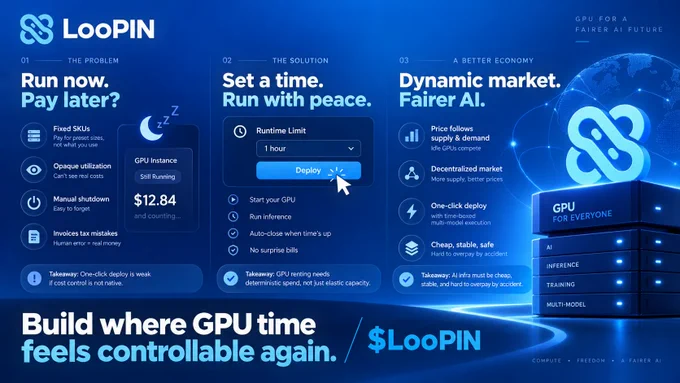
Rent a GPU for one hour. Run inference. Forget the console. Wake up to an idle instance still billing. That is not a UX bug. It is the economics of centralized GPU clouds: fixed SKUs, opaque utilization, manual shutdown, invoices that tax human error. Takeaway: one-click deploy is weak if cost control is not native. Runtime limits expose the missing primitive. Users set how long a deployment should run. When time is up, it auto-closes. The use case is simple: rent a GPU for an hour, finish the job, avoid surprise bills from forgetting to terminate. Takeaway: GPU renting needs deterministic spend, not just elastic capacity. Status quo sells convenience, then monetizes drift. Decentralized dynamic markets invert it. Price follows supply and demand, idle GPUs compete, and one-click deploy pairs with time-boxed multi-model execution. Takeaway: AI infra must be cheap, stable, and hard to overpay by accident. Build where GPU time feels controllable again with $LooPIN
AI is no longer just eating software. It is eating capacity. H100 queues, reserved instances, quota walls and volatile inference costs are not edge cases. They show compute becoming a balance-sheet asset and tradable input. GPUs are moving from infrastructure to market structure. Cloud won phase one with reliability, SLAs and scale. The cost: opaque pricing, chokepoints, lock-in, idle inventory and margin stacking. If hyperscaler cloud can top $1T by 2030, that is not revenue. It proves AI demand is turning compute into a macro market, and static pricing cannot clear dynamic demand. BlackRock has linked AI adoption to new demand, utility and apps across digital assets. The missing layer is execution: agents buying GPU capacity on programmable rails, settling in stablecoins and routing jobs to the cheapest supply. The next cloud is liquid GPU supply, dynamic pricing, one-click deployment and miner-friendly yield. Rent cheaper. Build faster. Keep AI open. $LooPIN

RTX 5090 owners are already being pulled into compute markets. A GPU sharing push asked for more RTX 5090s to join a Homenode AI Grid. The pitch: idle compute becomes profit share. Listed rate: $0.60/hr for RTX 5090 capacity. Another onboarding round wanted nodes with fewer than 4 GPUs and 16GB+ VRAM. The long tail of supply is real. The rails are not. Centralized GPU markets price like airports: scarce inventory, opaque markups, fixed packages, weak miner leverage. Small operators become overflow supply, not first-class infra. Buyers overpay for rigidity. Sellers wait for permission. Centralization turns idle silicon into someone else’s margin. Decentralized, dynamic GPU markets invert it: granular nodes, live pricing, model-driven demand, one-click deploy, stable cheap access. Miners plug in idle cards without becoming cloud sales teams. Users rent capacity without begging a hyperscaler. Put idle GPUs onchain. Democratize affordable AI compute with $LooPIN

The bear case for decentralized GPU just lost its cleanest attack: no demand. 3M+ jobs completed. 3M+ compute hours processed. Workloads were not vanity txs: AI inference, image generation, LLM security testing. Real users are routing real compute outside the default cloud stack. Takeaway: decentralized GPU has moved from narrative to utilization. Centralized model: fixed regions, opaque quotas, enterprise-first allocation, sticky pricing. When AI demand spikes, users absorb the spread through waitlists, reserved contracts, or margin compression. Dynamic model: idle GPUs enter the market, supply reprices fast, and buyers optimize latency, VRAM class, model size and duration. AI growth drives inference, burst, testing and experimentation demand. GPU-hours become scarcer, more financialized and more valuable. One-click deploy, dynamic pricing, broad model support and durable miner economics win the long tail. Affordable GPU access is the wedge for decentralized AI. $LooPIN

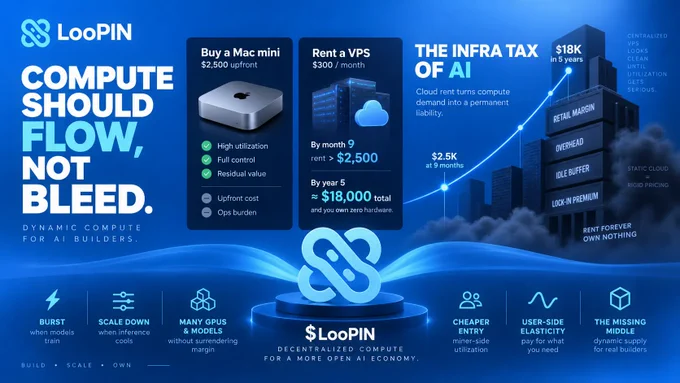
A creator buys a Mac mini for $2,500 and runs it near full capacity. Comparable VPS: about $300/mo. By month 9, rent exceeds the purchase price. By year 5, the VPS bill is roughly $18K, while the renter owns zero hardware. That is the infra tax of AI: cloud rent turns compute demand into a permanent liability. Centralized VPS looks clean until utilization gets serious. You pay retail margin, overhead, idle buffer, and lock-in premium. Buying hardware flips it: upfront capex, control, residual value, plus ops burden and less elasticity. One path bleeds cash slowly. The other concentrates risk upfront. The real issue is rigid pricing against variable GPU demand. AI builders need compute that behaves like liquidity: burst when models train, scale down when inference cools, access many GPUs and models without surrendering margin to static cloud menus. Decentralized dynamic supply is the missing middle: cheaper entry, miner-side utilization, user-side elasticity. $LooPIN
A team signs a 12-month GPU contract because it needs H100 capacity now. The training run lasts 3 months. The contract lasts 12. For the next 9 months, the bill keeps running at $30K/month even when demand is gone. That is not infrastructure. That is duration mismatch disguised as reliability. Centralized GPU markets push buyers to overcommit because supply is scarce, pricing is rigid, and access is gated by long-term reservation logic. Result: 40% of reserved capacity can sit idle under locked contracts while new builders are priced out of the same hardware. The better model is dynamic. Idle H100 capacity with 9 months left should not rot on a balance sheet. It should be monetized, routed, repriced, and rented by demand in real time. AI workloads are bursty. GPU markets should be burst-native. Unused compute is inventory, not waste. Decentralized GPU infra turns stranded supply into accessible compute: cheaper entry, shorter duration, one-click deploy. $LooPIN
