
Pleased to present 'tricycle', a new R package for rapid, accurate, and scalable estimation of cell cycle position for scRNA-Seq using transfer learning. A joint project from our lab and the lab of @KasperDHansen. doi.org/10.1101/2021.04.06.4…

 Open web. Clear feed.

Associate Professor @ JHU, explorer of single (brain) cells, chaotic/good, Dad^^2, My contributions to science not defined by my position on author lists.
Pleased to present 'tricycle', a new R package for rapid, accurate, and scalable estimation of cell cycle position for scRNA-Seq using transfer learning. A joint project from our lab and the lab of @KasperDHansen. doi.org/10.1101/2021.04.06.4…

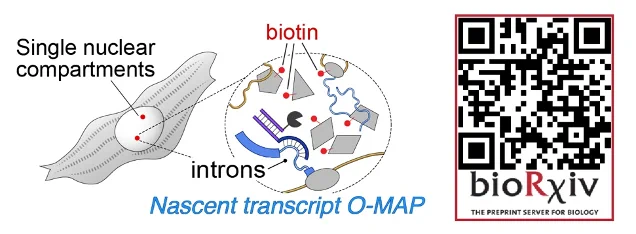
It's my pleasure to present the next big preprint from SheqLab! An exciting application of our O-MAP platform that I hope will transform the study of nuclear architecture. If you've ever wanted to dissect the subnuclear "neighborhood" around an individual locus, read on! (1/30)

Heading to #ASHG24 and looking for a postdoc position? Interested in genetic epidemiology, specifically gene x environment in diverse pediatric cohorts? I'll be here all week so find me to talk about opportunities with myself and @priya4genes at @jhugeneticepi in Baltimore!

My second manuscript from graduate school is now on bioRxiv! We generated a comprehensive scRNA-seq dataset of mouse OPCs from young adult to aged animals with the hope of providing a reference dataset for everyone to dig into! tinyurl.com/aging-opcs
Transcriptional profiles of murine oligodendrocyte precursor cells across the lifespan biorxiv.org/cgi/content/shor… #biorxiv_neursci

Without getting into the science itself, I wish everyone would read the editor's statement for the review of this manuscript. *This* is how the peer review system is supposed to work. It's a massive systems failure to instead be obssess w/ accept/reject. elifesciences.org/articles/8…


I want to boost the freshly published main PhD work of a @cahanLab colleague, Kathleen Noller, whose thoroughness and work ethic I especially admire. Short thread on something that I originally did not think was possible: academic.oup.com/bib/article…

Beyond thrilled to present our O-MAP—now *published* @naturemethods (!!!) O-MAP is a powerful new method for biochemically "dissecting" the subcellular microenvironment around an RNA of interest, using off-the-shelf parts and standard manipulations. 🧵 nature.com/articles/s41592-0…


A lot of molecular and cell and developmental biology is concerned with figuring out the "functions" of various proteins. I'm starting to distrust that formulation...

This recently published figure by @Sarah_E_Ancheta et al. is very disturbing and should lead to some deep introspection in the single-cell genomics community (I doubt it will). It demonstrates complete disagreement among 5 widely used "RNA velocity" methods 1/


Happy to be part of a multi-institutional effort through an academia-industry partnership in the systematic analysis of the WWE domain in human E3 ligases using our PAR labeling technology! nature.com/articles/s42003-0… @thesgconline @Boehringer @JohnsHopkinsBMB @UniofOxford @UofT

I am excited to share our most recent story led by our fantastic postdoc Lucas Serdar. How is steady state gene expression of the developing cerebral cortex controlled? The answer lies beyond transcription....biorxiv.org/content/10.1101/… 1/


📢 Our latest paper is out in @CellCellPress! Led by the multi-talented @XinheZheng, we accelerated AAV-based gene delivery to 2 days & enabled in vivo CRISPR screens with single cell-level readout, a leap from existing capabilities 🤯 How does it work? (1/8)


We're excited to announce this year's Whitman Fellows! The MBL will welcome 29 scientists from 27 universities and research institutes around the world. mbl.edu/news/mbl-awards-whit…

We're excited to announce this year's Whitman Fellows! The MBL will welcome 29 scientists from 27 universities and research institutes around the world. Learn more: mbl.edu/news/mbl-awards-whit…


We are halfway through the first ever Cephalopod Neuroscience Conference at the MBL. Over 200 participants. What an amazing expansion of new research. #cephneuro. sites.google.com/view/cephne…


Our paper "A machine readable specification for genomics assays" is now published in Bioinformatics, @OUPBioinfo. In short, we present a lightweight file format and command-line tool to document the structure of sequencing reads. Coauthored with @XiChenUoM and @lpachter. Paper: doi.org/10.1093/bioinformati… Code: github.com/pachterlab/seqspe… What is in my sequencing reads? Sequencing machines produce text files, called FASTQs, that contain reads or sequences of DNA molecules. Assay developers and data generators deeply understand the contents of their reads; they know the location and presence biological and synthetic constructs like cellular barcodes. Collaborators, reproducers, and other scientists may not despite their sometimes obscure addition to supplementary material. Take for example the @10xGenomics Multiome assay. The 10x Genomics documentation [1] spells out the read structure for each modality: RNA reads contain a synthetic 16bp barcode, a 12 bp "randomly" generated unique molecular barcode (UMI), as well as cDNA that was captured via polyA capture. The ATAC reads consist of genomic DNA and a 16bp cellular barcode. However the 10x Genomics website explains that the ATAC portion of the 10x Multiome data contains an little-known 8bp constant sequence spacer that proceeds the 16bp cell barcode. So saying that you have "10x Multiome" reads is a necessary but not sufficient condition to know the contents of your FASTQ reads. The reason is because the FASTQ read structure is dependent on both the assay as well as the sequencing machine/recipe used; a sequencing library produced from one single-cell assay can yield different read structures depending these parameters. Take the the 10x Multiome assay. The ATAC 24bp barcode + spacer is usually sequenced as the i5 index read. Since the NextSeq 500/550 does not support a 24bp i5 read, the user must specify "dark cycles" (10x details the impact of this [2]) to skip the 8bp spacer. This yields a 16bp cell barcode in the i5 FASTQ file. If, however, the 10x Multiome ATAC library was not sequenced with dark cycles then the i5 FASTQ file will contain a 24bp spacer + barcode. I was originally unaware of the 8bp spacer and the use of dark cycles in Multiome library sequencing. But as I was recently looking ATAC reads I realized the impact it had on my count matrices; I had been extracting half of the cell barcode and all of the spacer. This meant I was performing barcode error correction and was UMI collapsing the, mostly similar, cell barcodes to produce few counts. This decoupling of read structure between the sequencing machine and the assay places a high priority on documenting read structure in a sequencer and assay-specific manner so that preprocessing tools can accurately extract and process relevant sequenced elements. A machine-readable specification I was inspired by @XiChenUoM 's efforts (which started while in @teichlab) in documenting sequencing reads of assays and I came up with an idea to document read structure in a machine- and human-readable specification. The specification is called seqspec [3]. The specification details the structure of a YAML file that allows users to specify and annotate the types of sequences that are contained in their FASTQ data. seqspec uses a nested representation of "Regions" and "Reads" that allows users to annotate groups of sequenced elements and map sequencing reads to sequencing primers. This enables, for example, all of the elements contained in Read 1 of a FASTQ file, such as the barcode and UMI in the 10x RNA assay to be annotated as belonging to Read 1. The spec also comes with an accompanying seqspec command line tool which gives users who annotate their sequencing assays many benefits: 1. Reproducibility and verifiability of the assay structure 2. Positional extraction of relevant features 3. Visualization of the sequencing structure The seqspec command line tool makes it straightforward to extract the positional index of sequenced elements. The barcodes in the 10x Multiome dataset could have easily been identified as starting 8bp into the reads with the seqspec index command. The tool also also makes it straightforward to visualize the structure of your sequencing reads. seqspec print can produce publication-ready figure of your read structure. Most importantly, seqspec makes it easy for others to reanalyze data for which a seqspec exists, bringing about verifiability of analysis results. seqspec adoption seqspec aims to make genomics processing correct and reproducible. seqspec was recently adopted as the first standard in the @IGVFConsortium and we anticipate the publication of terabytes of sequencing data alongside their seqspec read annotations. I personally believe seqspec will be transformative for reproducibility and analysis efforts, in particular for those undertaken by consortia. I hope that public databases (like the @NCBI SRA/GEO and DDBJ) will test out seqspec and look to adopt it as a standard for data submission. seqspec is freely available, open source, open to contributions, useable, and well documented. Please take a look at the GitHub repo and try it out! We welcome feedback. [1] 10xgenomics.com/support/sing… [2] kb.10xgenomics.com/hc/en-us/… [3] github.com/pachterlab/seqspe…

