
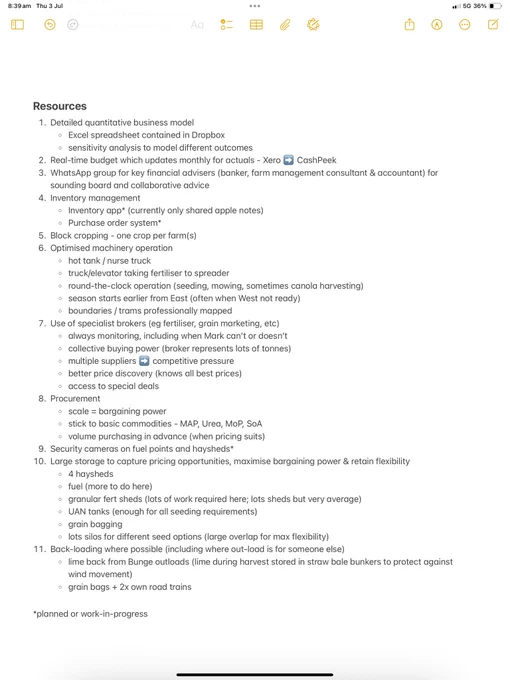
This is where I have got to. I’ve put a fair bit of our own know-how in here so my hope is that others are as willing to share so we can all benefit.



 Open web. Clear feed.

Farmer at Williams & Harrismith (Western Australia). Ex-lawyer (BDW, A&O) & army officer (RAAC/ARES).
This is where I have got to. I’ve put a fair bit of our own know-how in here so my hope is that others are as willing to share so we can all benefit.
When are people going to get it? Farmers do NOT monitor their emails all day long. Does my head in. If you want to get a message to a farmer right away (especially during harvest), send a text or WhatsApp message. It’s almost like they don’t want you to get it right away. 🤔

Truflex canola concerns: If you are affected by this, please contact the WAFarmers office for further information about your options. wafarmers.org.au/


This is the ON WAFarmers episode everyone has been waiting for - @mdfowler100 on Paraquat, phosphine, ISCC, and a long list of other critical wins and ongoing battles facing our sector. Mark also really points out why it is so important that people join an advocacy group. Let us know what you think, and share it with someone who you think needs to hear it! Enjoy: open.spotify.com/episode/2dh…

The story of our year. We even have baited the rain with hay on the deck. 158mm for the year at East Wickepin.

See our comments on: (a) the Senate’s decision to conduct a parliamentary inquiry into the APVMA’s recent decision on paraquat; and (b) the (misguided) support for that inquiry led by David Pocock but also voted for by the Coalition. @The_Nationals @LiberalAus @DavidPocock


This is what I sent @farmweekly (prepared earlier when the acquisition was first proposed and sets out @WAFarmersGrains thinking on this).


I definitely did not say that govt would do a better job than private ownership generally (as is perhaps implied) but that govt ownership would be better than ARC Infrastructure who are not maintaining or reinvesting in the line and applying excessive track access charges.
I have been misunderstood here. What I said was that, while govt ownership was not our preferred option, something has to be done to fix the currently unworkable situation. And govt ownership (for now) is preferable to the continued mismanagement by ARC Infrastructure.@farmweekly


After their biased and misguided reporting around paraquat, and this recent article asking why farmers should be exempt from the taxation of trusts, I really question why The @australian is suddenly so against farmers?
Labor’s 30 per cent discretionary trust tax spares farmers, but builders, doctors and other key industries face hikes and costly restructuring. Discover why: bit.ly/4gv0MlW

💯% - 110mm YTD in out patch with little or no rain forecast for the next week, a super El Niño and a developing +ve IOD. #qualitycliffface @DemeterCormack
Anyone else feeling like the “oatbelt” growing regions of WA could be in for a bit of a shock with new season oat production. Something tells me it’s going to get interesting. Whilst the old season price may not agree, watch this space
“Australian grain growers stood shoulder to shoulder with Syngenta in defending paraquat through years of regulatory scrutiny. To walk away after the APVMA confirmed the product could remain available sends the wrong message & undermines confidence in a vital agricultural tool.”


Syngenta’s paraquat withdrawal exposes how vulnerable Australian growers are when global commercial decisions reduce access to essential products. This exit raises serious questions about future investment in Australia’s crop protection market. More-> rebrand.ly/adf107
We have increased our on-farm fuel storage recently but, up till now (due to regular turnover), haven’t really needed to consider the difference between summer & winter fuel and possible carry over issues. How real is this and is it mainly going from summer into winter?


See my article that was submitted for publication days before the APVMA’s final decision on paraquat together with Farm Weekly commentary following that decision. A victory for science & law over misguided & sensational media & political campaigns (@australian @DavidPocock)!!


One of the most damaging ideas in modern risk communication is that hazard equals risk. IARC helped popularize this confusion. A hazard tells us what could cause harm. A risk tells us what is actually likely to cause harm at real-world exposure levels. Those are not the same thing. Yet for years, hazard classifications have been reported as if they were measures of real-world danger. The consequences have been enormous: • Public confusion. • Sensational headlines. • Multi-billion-dollar lawsuits. • Erosion of trust in regulatory science. And when everything looks dangerous, the public loses the ability to distinguish genuine risks from theoretical ones. Good science requires both hazard identification and risk assessment. Ignoring either one leads to bad decisions. The challenge is that only one of them tends to make headlines.

IARC has confused hazard with risk. IARC has promoted chemophobia IARC has fueled litigation. IARC is politicized. A decline of IARC would result in less fearmongering, fewer lawsuits and a greater reliance on risk assessments.
After the US government put a health warning on IARC's low quality research, @zaruk wonders what a post-IARC world will look like. Less fear, ignorance or useless lawsuits It will be better and no one will notice when the cancer agency crawls into oblivion thefirebreak.org/p/welcoming…


