🤖 Is the strongest AI model always the best coding agent?
We're excited to welcome Önder Ceylan to DevFest Istanbul 2026! 🎤
Discover how coding agents perform in real-world engineering workflows and why adapting to feedback can be more valuable than getting everything right on the first try.
📅 December 19, 2026
📍 Wyndham Grand Istanbul Levent
🎟️ Want to learn more? Find all the details through the devfest.istanbul!
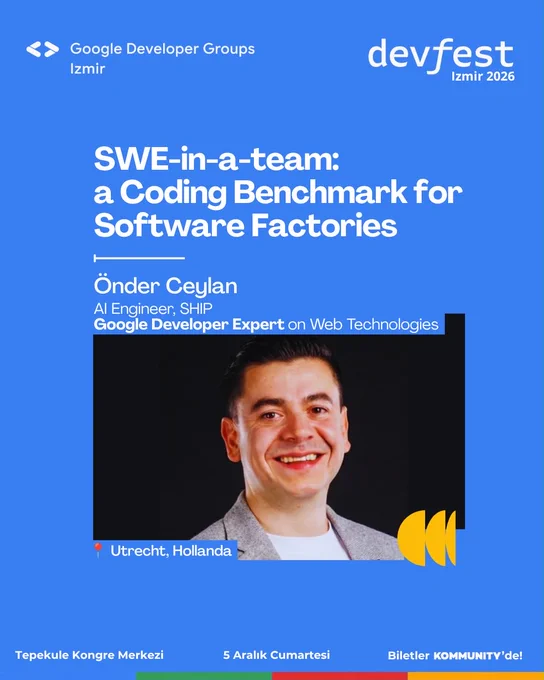
Önder Ceylan, “SWE-in-a-team: a Coding Benchmark for Software Factories” adlı konuşmasıyla DevFest’26 İzmir sahnesinde bizlerle! 🎤
Google Developer Expert olan @onderceylan , bu oturumda yazılım geliştirme süreçlerinde AI tabanlı ekiplerin ve software factory yaklaşımlarının nasıl değerlendirilebileceğini ele alacak. ⚙️
🎟️ Biletler Kommunity'de!
lnkd.in/dyveE5Rw#devfest26izmir#devfestizmir#devfest#googledevelopers
A decade as a tech lead taught me systems thinking, delegation and trusting my team. Turns out that's the exact skill set for running AI agents. The result still needs my judgment and taste. Someone else just writes the code.
And no, I don't review all of it anymore. My agent team on @letsshipai reviews and tests all the code they write.
My job is to design the system around what "good" looks like.
I stopped writing code after 27 years. My agents write it now.
Never enjoyed building software more.
The joy was never the typing. It was creating something from nothing. That hasn't changed. Only who writes the code has.
Oh, and we're still reviewing the code, right?
Right?
My fellow web developers, its time to celebrate responsively sized iframes on the web! 🍾
Responsive iframes are available from Chrome 154 onwards.
developer.chrome.com/blog/re…
Introducing SWE-in-a-team - a coding benchmark for software factories. On the day of the announcement of Fable 5.1, it becomes even more meaningful.
I created a brand new coding benchmark to grade a coding agent and model's performance while working on 20 tickets of a real-world like full-stack SaaS app in an autonomous SDLC loop - a software factory.
Here are some of the striking results from the research. When designated to a Builder role running in a loop:
💡 DeepSeek-v4-flash with Pi resolved all 20 tickets for $66.86 while Fable 5 resolved 19 tickets for $122.42.
💡 Haiku resolved the 18 tickets vs Fable's 19, but costed 52% less.
💡 Cheapest was Luna running on Codex with a cost at $3.08 resolving 16 tickets - that's the fewest ticket resolution rate in the research.
💡 Catching an issue late cost money - the 4 runs the Tester rejected ran to a median of $8.18 against $3.51 for a clean run, while the 27 CI rejected came in at $3.37.
Many practitioners from the industry has the reflex to use the best model they can afford, and this study suggests that reflex is wrong. You can as well choose the agent harness and a budget model your loop can correct and optimize your metrics like cycle time, and cost.
Read the methodology, inspect the PRs and mission replays, and download the data of all 260 runs from the research at letsship.ai/blog/swe-in-a-te…
POV: Demonstrate a 38 minutes long @letsshipai mission in 30 seconds.
AI agent fleet worked together in a software factory via pi - deepseek-v4-flash builder: four builder pushes and three rejections (CI twice, then the reviewer once) landed a resolved ticket in 38m 12s for $4.22.
Not bad for autonomously increasing your marketing site's SEO score from 45 to 100.
Hello world! SHIP is live and kicking and keeps building itself with the agent fleet ⛵
Our initial issue tracker integration is with @linear. But not because it's our #1 planning tool of choice.
@karrisaarinen and his team has been doing a fantastic job at Linear. SHIP works the best with agent native platforms, designed for the AI era. And, Linear is a great example.
Linear's Agent Session interface is a perfect starting point for creating agent conversation surfaces around a work item.
In the attached mission, SHIP's task is to takeover a broken PR which was vibecoded, and fix it by taking it through complete SDLC. I added a new instruction for the team mid-mission using Linear's Agent Session, and they have a side mission now.
Linear, welcome aboard! 🌊
Today is the launch day! Introducing SHIP - an agentic engineering platform that takes @linear tickets through complete software development lifecycle.
It runs an agent fleet that you configure for specialist roles of planning, development, review, ops, and testing, then reports what was delivered, how long it took, and what it cost with unusual precision in SDLC.
I built SHIP because coding agents are getting faster, software quality is getting out of control, teams are not able to cope with code generation speed, and AI bills are surging. Engineering teams still need quality gates, visibility into costs, and control over which agents and models they use.
With SHIP, specialist agents work together inside your existing development process, keeping agent harness, keys and contracts from your existing AI providers like @Google, @Copilot, @claudeai, @OpenAI or @OpenRouter. They take the work through autonomous CI, review and test gates in pull requests on @github, while your team stays in control of system design, approvals and exceptions.
The video below shows how it works. It builds a complete full-stack feature of a SaaS in about 30 minutes, for a few dollars.
I’d love to hear from engineering leaders and teams already experimenting with AI agents:
* Has AI helped your team ship better software, or simply produce more code?
* How do you connect AI spending to software that reaches production?
* Are coding agents reducing your delivery time, or simply moving the bottleneck to review and testing?
Tag someone you know below that would be interested in burning tickets autonomously with cheaper models, saving both time and money. SHIP is in closed beta, and I'm looking for 10 design partners to join the movement.
Looking forward to your thoughts, feedback and support on my new journey.
Learn more at: letsship.ai#AgenticEngineering#AgenticSDLC#AgentOS#SoftwareDevelopment#AI#DevTools#ClaudeCode#Codex#Pi#Copilot@GoogleDevExpert
Check the chart attached for comparison.
I'm going to publish my research soon with more proof, with a brand new agentic engineering benchmark the industry misses at the moment.
Reply with "haiku" below to get it first!
My research also proved that you could deliver more than 90% of your backlog tickets with Haiku doing the heavy lifting in your agentic SDLC. This setup requires a carefully designed agentic engineering system, so don't compare it to the outcome of a single engineer using Haiku.
This is exactly why Codex + GPT has seen massive surge in their usage.
What you probably don't know yet, is the fact that you don't really need to change providers or switch from one frontier model to another to reduce AI costs.
I've been conducting my own research for a new agentic coding benchmark. For an industry standard, pilot backlog ticket to go through all the stages of an agentic SDLC, fable costed $15, whereas gpt-5.6-sol costed $8.
OpenAI published their new gpt-5.6 model series right in this atmosphere, with their most powerful model variant Sol priced in a range of almost half of what Fable cost. Also interesting to see, context length of >272K input tokens is being punished with more cost by OpenAI.
With open-weight-triple-distilled-double-casked Chinese models heating up the competition - hi Kimi K3 -, and Anthropic increasing API prices and publishing the most expensive model in the world -Fable- the industry has started to demand smarter and cost-efficient solutions.
As industry finally awakens to their yearly AI budget burning faster than Dante's Inferno, engineering principles started to go back to basics - being cost-aware.