
 Open web. Clear feed.

20+ years experience in BD and channel sales for corporate clients. Now exploring my inner cypherpunk. Believe in something.

"The sanctions include freezing these people's assets and making it a crime for anyone in the EU to pay them, hire them or even lend them a single euro." Sanctuary tech cannot be built on centralized stablecoins. We need private, crypto-native currencies for our Parallel Polis.
By my own count, if one includes these latest sanctions, the EU has now sanctioned 8 European citizens for speech: - 3 German citizens: Alina Lipp, Thomas Röper and Hüseyin Doğru - 3 French citizens: Xavier Moreau, Adrien Bocquet and Sylvain Afoua (aka Egountchi Behanzin) - 1 Lithuanian citizen: Ernest Mackevičius - 1 Irish citizen: Chay Bowes The sanctions include freezing these people's assets and making it a crime for anyone in the EU to pay them, hire them or even lend them a single euro. They also include a travel ban, which leads to some absurd situations: Doğru - based in Germany - was invited by some members of the EU parliament to Brussels to plead his case but he couldn't go due to the travel ban. As one of the MEPs who invited him - and made 40 phone calls to try, unsuccessfully, to get him cleared to come - put it: "It really was like something out of a Kafka novel" (berliner-zeitung.de/article/…). And, probably worst of all, all of this was decided without any charge, trial or court ruling - simply as a unilateral decision of government ministers. Yesterday's sanctions, for instance, were decided at the Foreign Affairs Council meeting of EU Foreign Ministers and were simply signed by Kaja Kallas alone on behalf of the Council (eur-lex.europa.eu/legal-cont…). Put it all together, and this violates at least half a dozen of what the EU keeps saying are the fundamental values and principles it supposedly fights for: 1) Separation of powers: here we have government ministers - members of the executive branch of their countries - acting as prosecutor, judge and jury 2) Presumption of innocence (Article 48 of the EU’s own Charter of Fundamental Rights): they’re punished without guilt ever being established, and without being given a chance to plead their case before the decision 3) Right to a fair trial (Article 47): there was no trial at all, let alone a fair one 4) Freedom of expression and of the media (Article 11): they were sanctioned - explicitly so - for what they said and published. For instance, in these latest sanctions, Chay Bowes was sanctioned for, among other things, the speech crime of "participat[ing] in the spreading of anti-Western and anti-Ukraine disinformation at the UN Security Council" (eur-lex.europa.eu/legal-cont…). Sanctioned in part for a speech at the UN, a forum that exists precisely so that clashing views on international matters can be heard, quite the message to send from the EU... 5) Freedom of movement (Article 45): they're under a travel ban 6) Right to work and to property (Articles 15 and 17): their assets are frozen and nobody may employ or pay them You can think whatever you want about these 8 people. But ask yourself this: even if you are pro-Ukraine, pro-EU, anti-Russia and you view these people as malignant Russian operatives... what is the EU fighting for here, exactly? This is more profound than you may think: we're speaking about the very foundation of modern European civilization, built on the very idea that political power alone cannot decide what is true. I'm not exaggerating. What we’re witnessing is a return to the pre-Enlightenment playbook, when monarchic or religious authorities defined the truth, deviations from it were called heresy, and heretics were excommunicated - cut off from the community, so that no one could trade with them, employ them or help them. In Europe's darkest times, heretics were even famously burned at the stake - like Joan of Arc or Giordano Bruno. It took literal centuries of religious wars and debates, and the likes of Voltaire, Kant and Mill, to replace it with a basic idea: that no single power, however legitimate, gets to be the final judge of what is true, and that you answer for your words only before a court, under laws written via a process separate from the power that does the accusation. You can find countless works of European literature on this very matter. Take Spinoza, excommunicated in 1656 by the Portuguese-Jewish community of Amsterdam, with a decree ordering that "no one should communicate with him" nor "accord him any favor". He went on to write the Theological-Political Treatise, one of the founding texts of the Enlightenment, with an entire chapter arguing that "in a free state every man may think what he likes, and say what he thinks." Or Mill, two centuries later in On Liberty, Chapter 2: "All silencing of discussion is an assumption of infallibility." Or Kafka’s The Trial, the story of a man accused by an authority nobody can quite locate, of something nobody will explain. How is what Europe is presently doing anything other than going back to that very system, under new appellations? The authority: government ministers. The heresy: "disinformation". The excommunication: assets frozen, banned from travelling and nobody may pay them, hire them or lend them a single euro. It’s basically Spinoza’s excommunication decree on EU letterhead, with a bit of Kafka sprinkled in given that the man invited to the European Parliament to contest his punishment couldn’t attend because of the very punishment he wanted to contest. You don’t have to like these 8 people, or even care about them, to see the problem. Heck, this system was developed precisely for the people nobody likes: consensual ideas never needed protecting. No, the real question here is this: do you want Europe to be the heir of Spinoza - or of Voltaire, or of Galileo, or of any of the countless Europeans who suffered or even died for thinking differently - or of their persecutors?

funny how the moment jensen huang steps out of the picture, Nvidia immediately drops 10 billion dollars into anthropic shares, jensen spent the last few years championing an open ai ecosystem and open models that directly threatened closed frontier labs like anthropic by turning intelligence into an open layer running everywhere on nvidia hardware
JUST IN: Nvidia $NVDA to buy $10,000,000,000 in Anthropic shares.


Ok, this looks quite interesting... 👀
Coffer is live on Ethereum mainnet. Validators can now issue fixed-rate ETH bonds backed by their own stake, and anyone can buy one directly from them. No intermediaries, no oracles, no governance. Anyone who wants to run a validator can create a Coffer through the CofferFactory contract and use it as their withdrawal credentials, which gives them the ability to offer bonds at a rate and duration they choose. A holder pays ETH and receives a bond NFT with a fixed maturity value and date, both set on the day of purchase. ETH in, ETH out. Every bond is an onchain asset that can be held, traded or built on by anyone, with no permission needed. Each one is a direct agreement between a holder and a validator. Before buying, read how a bond works and what the risks are. App: coffer.bond Docs: docs.coffer.bond

I can't wait any longer, I want to be the first to get the new Ice wallet 😜 ambire.com/ice
Solana is a business, and you have to admire how aggressive they are in managing that business. Ethereum cannot compete, because it's not trying to compete. It's a decentralized protocol, like Bitcoin. Ethereum L2s, otoh, should be aggressively competing against Solana. Optimism, Arbitrum, what are they doing to build their business? Where did all that money go they once had in their treasuries? Maybe Polygon? Whatever happened to them, they've disappeared... Base is building an onchain business, of course, but they are managed by a Bitcoin maxi. So their heart is not in it, certainly not for Ethereum. Avalanche is building a business, but they are also anti-Ethereum. Most Ethereum L2s have been a massive letdown, so much wasted cash and mindshare.
1/ We’re excited to share that CoinGecko is entering our next phase of growth, backed by @SolanaFndn. Since 2014, we’ve helped millions of people discover, understand & navigate crypto markets. Today marks an exciting new chapter in that journey. 👇🧵

Amazon in the mid 2000's is exactly the analogy I have for Ethereum. AMZN did not return to its 1999 stock price high until October of 2009, 10 years later! During that time Amazon expanded beyond books, revenues increased 15x, and they turned cash flow positive. Bezos said he knew they would eventually win big because the business just kept dominating in multiple, high-growth segments.
$ETH is the Amazon of Crypto. But better.

This is a key thesis of mine: wallets that can build a strong, differentiated brand on top of a clear value prop (e.g. best security, total privacy, cypherpunk, meme trading, etc.) should win big. Users will do more in the wallet, they will trust the wallet provider to ensure greater security, reasonable fees, and align in-app, curated partner options with community values. If @ambire, for example, add prediction markets directly within their app, they will not likely use @Polymarket, but @Trueo_. Why? Trueo is better aligned with their cypherpunk values, and what their users probably want (note: this is just my opinion, man, I'm not part of the Ambire team). Just after DeFi Summer, Metamask was doing over $200 million in annual revenue! Those fee volumes are going to come back, eventually, as crypto grows. However, in the coming wave, I believe it will be a handful of wallet apps that capture that value, not just one (although Metamask will likely remain a major player). Wallets that can break out now and build their brand will be cash generators. I wrote about Ambire Wallet here: x.com/pray_eth/status/212007… Am I wrong? I'd love to hear counterarguments!
Some said L2s were sticky because liquidity, while wallets should be non-sticky as account import is trivial. In reality it's the opposite: L2s get flighty mercenary capital, while wallets are very sticky and feel little competitive pressure. Gotta turn up the heat 🌸
Greetings @VadimWeb3. Your Telegram account is compromised and sending out scam links. Please warn your contacts. cc: @MalyukovPetr

The guy starts a company, invents a new technology, then is dethroned by a board composed of virtue faking empty suits who never did anything other than powerpoint presentations, while the Epstein crowd is enjoying champagne parties. His personal life is none of their business.
JUST IN: Jensen Huang discusses returning as Nvidia $NVDA CEO with allies.


One of the upcoming things I'm most excited about from @tacitfi: you can turn your USDT on Ethereum into BTC on the Bitcoin blockchain, privately, with no custodian. Or sell BTC for USDT on Bitcoin and receive it privately on Ethereum. 👀 The bridge is live today: any shielded ERC-20 can cross to Bitcoin as a private note. USDT market in the app coming soon. We are finally connecting Bitcoin and Ethereum without 3rd party custodians, privately. So many possibilities!

I can always spot people who, like me, spent years slaving in the corporate world before embracing magic internet money. It's easy to posture as a cypherpunk elitist or surrender to corporate greed. The true revolutionary lives in those fertile verges between hope and despair.
gabriel shapiro @lex_node Feb 24 Article ETH is Cyberpunk Money I've been asking myself why I hold $ETH, whether I want to keep holding it, and why I think it's valuable. My friends and colleagues mostly hold one of three theses on ETH: "Bitcoin+": a store of
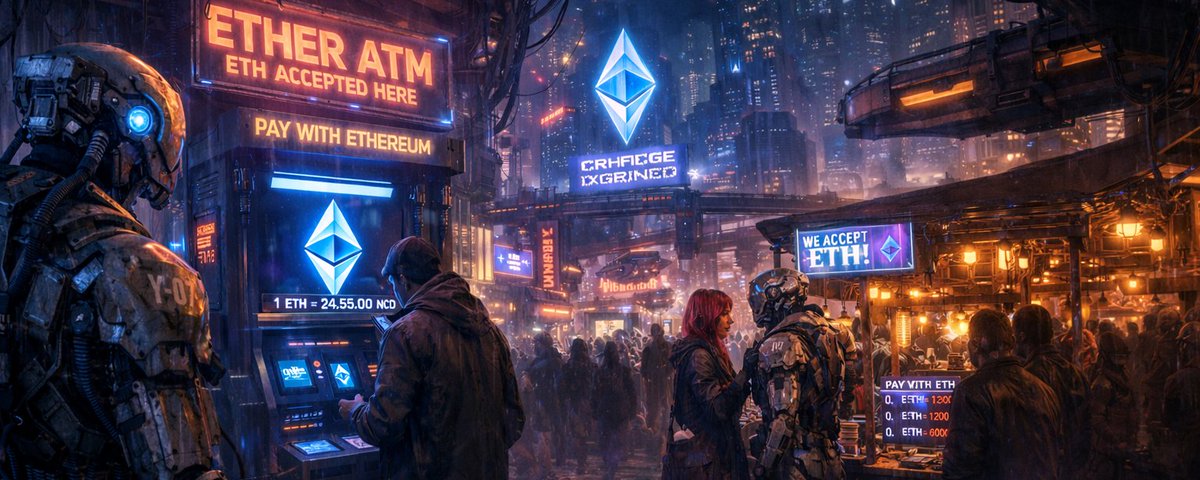

Institutions are soul-sucking devices devoid of any capacity to support progress Instead of bending DeFi into ReTardFi to capture their crumbs, we just need to achieve our vision Institutions will come back in 5 years to buy at 10x the current price and they will be happy
I wrote this two months ago, when ETH was around $2700. Good news is you can once again purchase ETH for a ridiculously low price. Few inside crypto understand the importance and uniqueness of Ethereum, forget about the wider public. Now's your chance, anon, don't screw this up.
Please stop the “bull market” euphoria. ETH is not going to 5k anytime soon. The world economy is in shambles, we’re almost out of diesel, and the orange idiot is about to escalate the Iran War. At best we tread water, more likely we go much lower.


