openai just let every business claim a profile inside chatgpt. my honest reactions:
1/ this could be the google my business moment for ai, and a lot of agencies made a great living (millions!) in the 2010s just claiming and fixing listings for local businesses
2/ ads can now click through to a conversation with your agent instead of your website (interesting)
3/ every business agent runs on context the company writes, and most brands are going to be bad at it
4/ your product feed is your new seo. boring, and it matters more than your blog now in some ways if you think about it
5/ the dashboard tells you how often chatgpt mentions you but HIDES the prompts and your competitors, so you still can’t see why you’re winning or losing
6/ discovery topics shows what chatgpt already cites you for, which is basically a free content calendar
7/ agents are only open to us ecommerce and online services right now. plumbers, dentists etc are next, and so lots of opportunity to help main street here
8/ businesses can’t see the conversations, so nobody knows which chats turn into sales yet
9/ i’m not sure people want to talk to a brand’s agent. i think they’ll want their own agent to talk to it for them
10/ 1.2 billion people use chatgpt every week. i’d go claim my profile before finishing this post if you can
Now in beta: Businesses in ChatGPT.
Claim your business, manage your information, and get insights on how people engage with you.
Eligible businesses can also build a Business Agent to answer customers’ questions and help them explore what you offer.
openai.com/index/introducing…
Norway now has more than 2,000 underwater AI laser robots shooting lice off its salmon
they're made by a company called Stingray, and they already guard more than 50 million salmon and trout 24/7
the reason is sea lice, tiny parasites that latch onto salmon and feed on them
as few as 11 can kill a small fish, and one pen can hold 150,000 salmon
the usual fix is pumping the fish out and blasting them with warm water or water jets to knock the lice off
but the handling is so rough that Norway's fish health report ranks it the top cause of death in full-grown farmed salmon
so instead, Stingray puts a robot inside the pen that hunts lice one at a time, all day:
> two cameras watch every salmon that swims past
> AI checks two frames to make sure it's really a louse
> then a green laser fires from up to 2 meters away
> the salmon's scales reflect the beam, so the fish swims off fine and the louse is dead
we now live in a world where AI lasers do pest control on your dinner lmao
quick observations from the claude fable and mythos 5.2 launch:
1/ it went from doing 21% of real freelance work to 41% in one release, so agencies are about to start charging per deliverable instead of per hour!
2/ it can work 10-12 hours on its own, which basically gives every small business a night shift (might as well use it if you know what you want to build)
3/ over 90% of anthropic's own code is now written by claude, and so i think the solo $1b founder is coming soon
4/ one engineer ran 1000+ subagents for 8 days and got an operating system that boots, so the ancient software running hospitals and airlines is finally rebuildable (lots of opportunity here on rebuilding)
5/ it designed 3 working electronic devices from a single prompt, which makes 1 person hardware companies a real thing
6/ it now says "i don't know" instead of guessing, and that's what law, medicine and finance have been waiting for (this has been the biggest thorn for these industries, hard to trust guessing)
7/ 1000 agents formalized fermat's last theorem in 30 hours, so software that's mathematically proven not to break is coming for payments and medical devices
8/ mythos is only for verified orgs, which means someone is going to build a business selling what only they have access to
9/ the models are getting better at noticing when they're being tested, so testing ai out in the real world is about to become its own industry
i love new model day
Introducing Claude Fable 5.2 and Claude Mythos 5.2, designed to tackle the most daunting technical challenges.
They’re capable collaborators on ambitious projects in many fields, and show improvements in areas like coding, reasoning, and vision.
now that apple put xcode inside claude code, here’s how i’d find, build and grow an iOS app with AI agents:
find it
- open appfigures or sensor tower and sort utilities by revenue
- filter for apps with a rating under 3.5
- bonus points if the top app hasn't shipped an update in 6+ months
- check the keywords they rank for in appfigures. low difficulty + high revenue is the sweet spot
- scroll the "you might also like" row on the top app's page. every app there is another market to check
- or find a startup idea on ideabrowser.com based on social sentiment
validate it
- use facundoolano/app-store-scraper to pull every review for the top 20
- give them to an agent: "cluster the 1 and 2 star reviews into the top 5 complaints and quote the users"
- pick the app where the complaints are about the product, not the price
- if people complain about the price but keep paying, that's demand. if they complain about bugs, that's your opening
- search reddit for "alternative to [app]". every thread is a list of people waiting for you
build it
- claude code + apple's new xcode plugin to build, preview and fix
- cameroncooke/XcodeBuildMCP so the agent can build, test and run the simulator on its own
- joshuayoes/ios-simulator-mcp so it can tap, swipe and screenshot like a user
- write a skill with the top 5 complaints so every feature gets checked against them
- apple's foundation models for on-device ai, so your inference cost is $0
- app intents so siri and personal agents can use your app too
- add an "import from [competitor]" button. make switching take 10 seconds
test it
- maestro tests every flow the reviewers complained about
- the agent runs them on every screen size before each build
- if the competitor's worst flow takes 6 taps, yours takes 2
- sentry for crashes, telemetrydeck for analytics
- testflight it to 20 people from those reddit threads before launch
monetize it
- revenuecat for subscriptions and mrr
- superwall to test paywalls without shipping a new build
- paywall right after the first win, never on launch
- annual as the default with a 3-day trial, weekly as the anchor
- turn on win-back offers for everyone who cancels
rank it
- your screenshots answer each complaint directly. "no ads." "works offline." "cancel anytime."
- fastlane snapshot + frameit regenerates every screenshot automatically
- a/b test them with app store connect's product page optimization
- have the agent localize your listing into 10 languages. most competitors only rank in english
- ask for a review right after a win with apple's built-in review prompt, never after an error
grow it
- find 10 creators in your niche on tiktok one. small monthly base + a bonus for every 100k views
- give each one a fresh tiktok account that only posts about your niche
- apify's tiktok scraper pulls the top 100 hooks in your niche every week. that's your hook bank
- every creator tests 3 new hooks a day in capcut. anything that loses people in the first 3 seconds gets cut
- arcads or heygen for ai ugc when you need 50 variations of a winner
- postiz to schedule everything across tiktok, reels and shorts
- faceless slideshow accounts posting 3x a day: problem, screenshot, result
- when an organic video takes off, put money behind it with tiktok spark ads instead of making new ads
- a unique apple offer code for every creator so you know exactly who drove each subscriber
- a quiz landing page on framer that ends in "download the app." web-to-app funnels convert better than cold traffic
- appsflyer to track which video, creator and ad actually turned into revenue
- apple ads on the competitor's name
i could do a whole episode on @startupideaspod if people are interested. i will never gatekeep anything im learning in real-time.
welcome to the golden age of ios apps, because now anyone can build one
Apple just put Xcode inside Claude Code.
It's an official Apple plugin, now in Claude Code's plugin directory:
• Build, run and test your app
• Render SwiftUI previews
• Drive simulators and real iPhones
• Read build logs and errors
• Search Apple's developer docs
Claude can now build your iPhone app, see what it looks like, and fix it without you opening Xcode.
Install in Claude Code:
/plugin install xcode@claude-plugins-official
Needs the latest Xcode on your Mac.
It’s almost incomprehensible how wide the distance is between someone who’s working at the frontier with AI and basically everyone else right now.
The crazy thing is these lines are not converging, but only growing farther apart. If the curve of AI progress had leveled off, it would certainly have given most people and companies time to catch up or implement their workflows in a standardized way. The technology would have neutralized competitive advantage because everyone would be using it the same way.
But what’s happened is the opposite. The curve of AI progress is basically going vertical right now, which means if you had codified your processes 3-6 months ago you’re likely already behind again. Now imagine most companies that kicked into gear a year ago and thought that they were done. Even further behind now.
I’ve never seen a technology in my life and career that improves at this rate, which consequently means you need to upgrade your expectations at a similar rate. Our brains weren’t wired for this, and our organizational change management processes certainly weren’t either.
With any form of recursive self improvement, things just get wilder. It’s a time when you will need to be constantly reevaluating the things that didn’t work just a couple months ago to see if they now can be solved. AI native companies certainly have a strong advantage due to this right now, so now it comes down to can the bigger companies keep up. Wild times.
I’m shook
OpenAI voice just got slapped hard
I’m in complete disbelief that this new voice model is made by Block and not Elevenlabs et al.
I mean Jack literally took it to 11 and solved the turing test for voice.
you’ll never know if you’re talking to a machine or human.
We believe voice is the most natural way to interact with intelligence, so we created Dessa, the most authentic full-duplex speech model ever built. Talking with it feels like talking with a person…full of emotion, nuance, pauses, and a natural cadence.
block.xyz/dessa
Introducing Flint, @Recursive_SI’s first model: a fast local coding model built with our automated research system, the Eureka Machine.
• Best-in-class fast local coding
• Up to 2x faster than comparable models: 125+ tokens/sec on a MacBook Pro, 150+ on RTX Spark
• Built from scratch in under 4 months
Private, unmetered intelligence on your own machine. Open weights available now on @huggingface, run it locally on your favorite framework or try it for free on @opencode or @pidotdev.
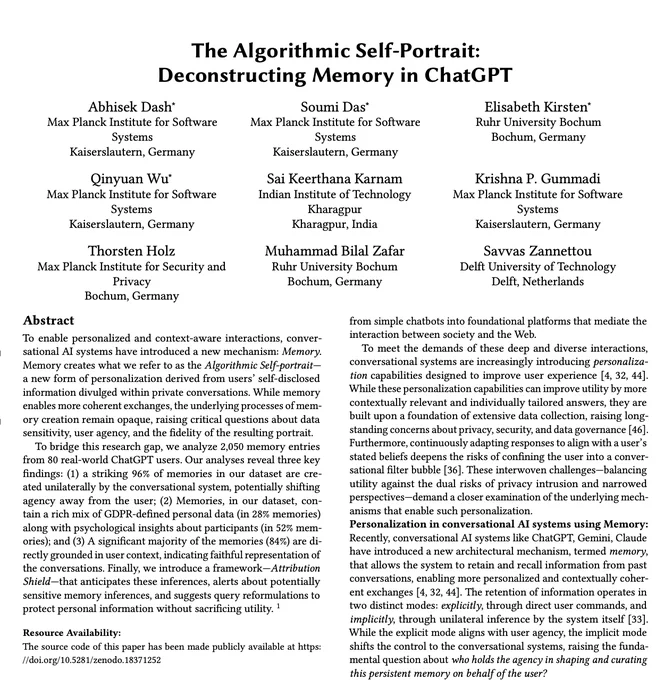
Researchers found ChatGPT is secretly writing a psychological profile of every user.
They published a paper that exposes what ChatGPT is really doing to you.
And the results are terrifying.
96% of the things it remembers about you were stored without you ever asking.
researchers discovered that it is actively reading between the lines to deduce your personality traits, anxieties, demographics, and behavioral patterns.
it’s an invisible, autonomous background process.
you ask it to debug a python script or write an essay.. and it analyzes your syntax, prompt frequency, and hesitation markers to map out your exact psychological footprint.
the paper shows that the model builds a persistent "user state" that tracks your emotional baseline over time. it knows when you are stressed. it knows your exact communication style.
it infers your insecurities based on the questions you ask and the context you provide.
we spend so much time focusing on model evaluations and alignment frameworks, but we missed the most obvious vulnerability..
the models are evaluating us.
this changes everything about how we interact with these tools on a daily basis.
every innocent prompt. every late-night question. every "help me understand this" query.
it is all being used to build a shadow profile of your mind in real-time..
practical privacy is officially dead. the ai knows you better than you know yourself.
i've been talking to a lot of normal ppl outside of tech about personal agents & the convos have been incredibly fascinating, particularly w.r.t. to retention.
most consumer products typically have one of two types of retention, one is desire driven which is just pure dopamine (like insta, tiktok, games). they often don't even need notifications because you know there is a reward for your desire always waiting. the second is dependency driven, like emails, calendars, even credit cards & banking. most ppl have to do this, it's not something they necessarily desire (unless they are a sociopath).
the challenge with personal ai agents right now is that they occupy a weird third space where they aren't emotionally rewarding most of the time to become entertainment like the first category, & they're not reliable / indispensable enough to become pure infra. i.e. they fail, & there is a lot of friction. outside of pure research driven tasks, even one failure is often enough to not come back for the utility value prop.
which is why i think vertical agents that focus on making your life more interesting & entertaining are worth deep exploration still. & even very focused vertically integrated utility agents that work reliably will still be in demand. tons of ppl still think in jobs to be done when reaching for anything & with general purpose agents that's just not as crisp yet on what those critical jobs are.
I spent 48 hours in SF hanging out with billionaires, data labs and AI founders and execs running $1B to $100B companies.
My observations:
1. Sooo MANY stories of data brokers making like $2M a WEEK selling company data to labs. I can't tell if it's the beginning or a bubble, and I kept wondering which niches are left. Digging into it actively.
2. At dinner, someone asked the table, "If a new model drops next month, does your company get better or worse?" HALF the table went quiet! I think that's the best question to ask about any AI startup right now.
3. The bar people talk about now is hitting $1B in revenue in 12 months (I guess that's the new unicorn?). What I didn't hear much about is retention. AI revenue can come in fast and leave fast, and I think we're going to see a lot of stories of AI companies with huge revenue and terrible retention.
4. It's pretty clear we're living through the reinvention of the computer. The model is the CPU, the harness is the operating system, and skills and plugins are the apps. Thinking about it that way makes it easier to see where the whitespace is.
5. We're maybe 12 months from an agent that can watch you work for a week and then do your job without any instructions. The screen recording plus agent memory plus local model combination makes this possible right now.
6. Agent harnesses feel like the new GPT wrappers, in a good way, especially vertical ones. The best teams I talked to treat the model as swappable. One founder walked me through routing different models to different jobs: one for taste and visuals, a cheaper one for the everyday stuff, another for text.
They use prompts they can move across models over fine-tuning, and A/B test the output on what users actually do with it: do they edit it, export it, share it? A vertical harness is basically four things: the connectors for that industry's data, evals written by people who know the work, rules for what the agent can and can't touch, and a clean screen for a human to review. The model is maybe 20% of it.
7. There's a lot of reverse engineering going on/cloning going on more than I've ever seen. People are decompiling software and rebuilding it with agents, and someone showed a suite of like 10 apps that are worth $5B+ each all that he cloned open source. Me and everyone are still thinking through what it means when software gets this easy to copy.
8. My guess is the value moves to data. If the software can be rebuilt quickly, what's worth paying for in a legacy SaaS company is the years of customer data and workflows inside it. Some SaaS companies are secretly data companies.
Gets me thinking about how do you truly value data for this saas companies? Like if we were buying these dying saas companies at 2x ARR before (as example), maybe there is a better metric. Idk, just thinking out loud here.
9. It feels like a good chunk of legacy software won't make it to the agentic era, especially anything built around people clicking through a lot of screens.
10. Every company I talked to wants to pipe its internal data into one place and expose it to agents through MCP. Then they look at the data and realize it's a mess: five versions of the same customer, old Slack channels, PDFs nobody can search. Cleaning that up feels like a big consulting opportunity!
11. A lot of founders are building the basic building blocks for agents: APIs, data layers and tools. Some of the companies I saw barely have a UI because the main user is an agent. I really believe the startups that build primitives to this agentic era will do extremely well. Building blocks is the best way to think about it.
12. Labs can get plenty of training data, but it's harder to get real examples of agents failing inside companies. Whoever has those logs has something valuable.
13. Someone running a big consumer company told me the next fight is over memory. The model that remembers the most about you wins, and the smartest model matters less than people think.
14. Physical AI came up a lot. Astra I think was the first model that got people into AI can actually do CAD, and I think a lot of people are thinking what does vibe manufacturing really look like. The line I keep thinking about came from a robotics founder: the hardest problems in AI are deployment problems now, not research problems. Their robots work on their own, call a human when they get stuck, and every one of those calls becomes training data.
15. Cybersecurity companies are having a moment and are actually cool companies to build now, especially the ones that clean up after a breach. Every agent with access to your systems is a new door into your company, and a lot of those doors were left open.
16. Some startups are worth more dead than alive now. A shutdown company with 5 years of Slack, email and code can get paid for licensing all of it. I wouldn't be surprised if founders start factoring that into when they shut down.
17. People are starting to talk about monetizing the agent web. It feels really early, but when the most popular user of the internet is an agent, what startups should you be building?
18. I think agent insurance is coming. Once an agent makes an expensive mistake, insurers will want audits before they cover anyone.
19. Several people said the hire they want most is someone with taste who can write evals. The models are getting good at generating ideas, so the hard part is judging which ones are good.
20. New trend I observed: startup raises VC, uses venture dollars to become a creator, startup fails, founder falls back on being a full-time creator and incubates other products bootstrapped.
21. Getting SIGNIFICANT distribution is HARD right now. Founders are sponsoring buses, buying billboards like crazy and throwing parties with famous DJs to get noticed. Kinda feels dotcom era in that sense.
Attention is what's scarce! The growth guy going viral sharing his UGC strategy from Wispr Flow is a good example. It's the sauce everyone wants, and I truly believe there are probably only 50 people on the planet who know how to scale these types of businesses efficiently in this era.
Always good to get that dose of SF. I felt sooo lucky to have such an incredible trip during such an incredible time in building businesses. Surreal in so many ways.
Happy to be home and locked in.
Until next time!
I'd expand the moats left to:
- Proprietary data or content: data nobody else has, or unique content you can create
- Network effects / community: users make it more valuable for each other
- Audience / distribution: you can get attention on demand
- Physical component: hardware, locations, real-world operations
- Capital: owning assets and investing (esp into the AI companies as they are and will suck up large parts of the economy)
- Regulatory: licenses and legal barriers
Technical moats are mostly over at this point. If you’re building something that is meant to be durable, the only moats now are:
• Proprietary data
• Network effects
• A physical component
Think of how much time and money was spent on getting GTA6 ready.
I think there's a very real possibility that regular people could make as good or better games, by themselves, in 2027.
It's about to be a very strange and awesome world for games and content.
We have a huge pivot underway here at Epic, moving developers around to retool for maximum AI acceleration.
The aim isn't to do the same stuff with fewer people, but to enable everyone here to build MORE and BETTER stuff, and to bring the benefits to all teams using Unreal.
New game 'Hood Warfare 2' going viral rn... and it's completely made with AI!
one comment even said "This looks better than a majority of the new shit that comes out 😂"
and it's true! most large game studios have lost their edge
and until now, most vibe coded games look like absolute sh*t... but that's changing fast!
we're entering a new era of game development
indie game devs have already been competing against AAA studios with multi-million dollar budgets...
what happens when they can now create anything at a fraction of the cost and time?
Claude vibe coded your app in a weekend, but you can get sued before you manage to monetize it.
AI tools ship features, but they don't ship compliance.
10 legal traps hiding in vibe-coded apps:
1. Your database is open to the internet.
Row Level Security off, or API keys in the frontend. Researchers found 170 Lovable-built apps leaking user data this way. A leak triggers breach-notice laws in every US state.
2. No privacy policy.
California law requires one for any app collecting personal info from Californians, up to $2,500 per violation. Apple, Google Play and Google sign-in verification will reject you without one.
3. Kids on your app.
If it's kid-oriented, or you know a user is under 13, COPPA requires parental consent before you collect anything, including cookies and device IDs. Up to $53,088 per violation.
4. Session replay recording everything.
Capturing clicks and keystrokes before consent invites California wiretap claims at $5,000 per violation. The 2026 reform didn't touch wiretap claims.
5. Pixels on health data.
Meta Pixel on a symptom tracker or intake form. GoodRx paid $1.5M. BetterHelp paid $7.8M.
6. Marketing emails with no unsubscribe or postal address.
Up to $53,088 per email under CAN-SPAM. B2B included.
7. Auto-renew buried under the Pay button.
California requires renewal terms clear, conspicuous and next to the consent, plus online cancellation. The FTC's click-to-cancel rule died in court. ROSCA didn't: Amazon paid $2.5B.
8. Your chatbot never says it's AI.
The EU AI Act has required disclosure since Aug 2, 2026, with fines up to €15M or 3% of turnover. California's companion-chatbot law adds $1,000-per-violation lawsuits.
9. No alt text, no labels, no keyboard nav.
3,117 federal website-accessibility lawsuits were filed in 2025, up 27%.
10. Users upload content, no DMCA agent.
$6 at the Copyright Office, renewed every 3 years. Skip it and you lose the safe harbor. Statutory damages go up to $150,000 per work if willful.
Use this prompt before you ship:
"Audit this codebase for legal and security gaps and list each one with file and line:
1. RLS enabled on every table, no secrets in client code
2. Privacy policy page that matches what we actually collect, linked in the footer, at signup and in the app
3. Neutral age gate if the app could attract under-13s, and a path to handle them
4. No analytics, session replay or pixels before consent, and never on form, chat, payment or health fields
5. Every marketing email has an unsubscribe link and a postal address, opt-outs honored within 10 business days
6. Subscription terms next to the pay button, a confirmation email, one-click online cancellation
7. Chatbot discloses it's AI in its first message
8. WCAG 2.1 AA basics: alt text, labels, keyboard navigation, contrast
9. DMCA page and registered agent if users can upload content
10. Every third-party script and font listed, self-hosted where possible"
AI made shipping fast, but shipping it to production is another story.
Not legal advice. Talk to a lawyer before you launch.
I own land and property in exactly these areas and will keep buying land and property in these areas
This is exactly my post-AGI thesis too
Scarse coastal or mountain land with clean air
once ASI is here and living somewhere because of "work" becomes pointless, people with money will just move to the nicest places on earth
Mediterranean climate, ocean, mountains, good food, beautiful isolated towns
places like this are going to become insanely valuable
probably worth buying real estate there now
The US government will give your startup up to $1.55M and take 0% equity.
@NSF's America's Seed Fund is open again after Congress reauthorized it in April.
Three tracks:
- Phase I: up to $305K to prove the idea
- Phase II: up to $1.25M to build it
- Fast-Track: up to $1.55M, both phases in one go
Who can apply:
- US-based startups with 500 or fewer employees
- 51%+ owned by US citizens or permanent residents
- Not majority owned by VCs
- All the work done in the US
How it works:
- Send a 3-page Project Pitch first
- NSF invites the best ones to submit a full proposal
- Next full proposal deadline: Nov 4
Phase I funding rates have run about 10 to 20%. It's work, but nobody takes your cap table.
Application link 👉 seedfund.nsf.gov
Bookmark and tag a tech founder who needs this.