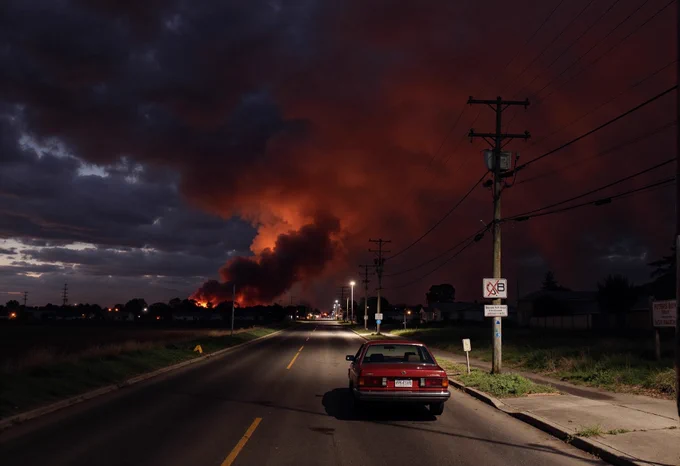
The First Palace Episode 6: "A Personal Interest" It's people acting. But it's not people.
5:23
 Open web. Clear feed.
 ✓
Creative AI Lead @ Supercell - working on the future of mobile entertainment AI Artist: "LIWA" + more. Creating @beatbanditai - AI-powered writers' room.
The First Palace Episode 6: "A Personal Interest" It's people acting. But it's not people.
@BeatBanditAI is available at beatbandit.ai or with the MCP ( beatbandit.ai/mcp ) Check it out if you're serious about making your stories better!
So for any issue highlighted, press "Work on this", fill out "what you would like to change?" and BeatBandit will ponder the improvement for this particular setup, giving you all the story beats AND the screenplay pages you need to change to make the setup and payoff work!


Latest BeatBandit feature: Setups & Payoffs Analyse any screenplay - a new one you've made inside BeatBandit, or an existing one you import in - and ask it to map out the setups & payoffs in your script. It'll find and map out all of them, showing which ones work well, which ones have some issues, and which one are lacking: have a setup but no good payoff (or vice versa). You can click on each, and it shows the exact moments in the script where it's first set up, then moments when it's kept alive, and then the payoff(s) as they happen. Super handy for finding issues... And not just for finding them, but you can then ask BeatBandit to fix them! See how 🧵


I find this story deeply sad and tragic. Mass hysteria (which is nothing but wrong beliefs running riot through a population like a virus) do real and lasting damage to people and communities. This lady helped block a data center that would have brought in tens of billions in local taxes, that would have occupied an empty lot that used to be a shopping mall 24 years ago. The community is struggling. They lost a Six Flags. The Washington Commanders are leaving. After helping block this data center, over imaginary problems like poisoning local water (that really, literally, does not exist and is not a real problem) she asked her struggling community to make a roof fund to fix her father's house. I give her that maybe the noise *could* have been a problem if there were diesel generators but it could have been addressed with simple requirements from the community such as sound walls or putting the generators further out and all of it it would have brought real growth to a struggling area. That's how basic democracy should work. Compromise and realistic solutions. Her father compared her to Medger Evans, a civil rights leader and WWII veteran who fought to end segregation and who was tragically assassinated. This is just an insane comparison and it's emblematic of what happens when we're in the midst of mass hysteria, where people imagine they're heroes in some cosmic struggle with no bearing on reality. A lot of folks are posting snarky takes on this. There is nothing to laugh at here. This is a total and complete tragedy at every level. And that is the nature of mass hysteria. In the Satanic Panic in the 80s, a couple went to jail for 30 years for "transporting children to Mexico to perform dark masses and so Satan could molest them" with literally *no evidence* because "Satan made the evidence disappear." This is the nature of mass psychogenic illness. It's born of fear and irrational, insane beliefs and when these false beliefs take root in a society, they do real lasting damage to people's lives. npr.org/2026/11/07/nx-s1-600…
Today at work I heard the term "human tokens": "let's spend some human tokens on this". A person, when thinking, will write about 1000 tokens per hour. So one million tokens is 1000 hours. Assuming a person earns 50 dollars per hour, the cost is then 500000 dollars per one million output tokens. Astra costs 50 dollars per one million output tokens. So: human thinking costs 10000 times as much as Astra thinking!

Proud to take part in this project! A long time in the making. Incredible art throughout the book - unique art from 128 artists!
BeatBandit development - I have now a quite complex workflow where agent has an overall goal (here, improve quality of the genres system), and then it writes, analyses with independent agents, writes hypothesis, implements them, tests, validates - the provenly successful one (through quite rigorous criteria) get into production. It's running 24/7 basically, optimizing the harness and ruleset. Different agents also check that improvements in one area do not lead to quality degrading elsewhere. If you believe you can guess which prompts work better, and guess that results got better because of your changes, more power to you! - but - if you can't systematically measure, how can you optimize? Anyway, crazy world.


the fact that it's now very easy to mock up an environment image with genAI and then ask Blender to turn that into a 3d model and even in its quite unrefined state (you could ask it to refine it many times) it's still very useful Spatial consistency issues will be solved during 2027.