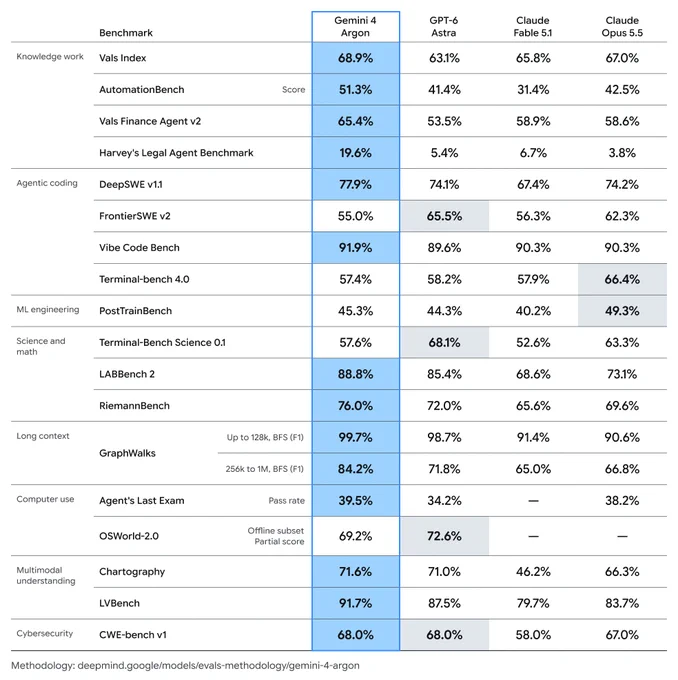
Gemini 4 Argon is our next era of frontier intelligence.
It shows significant improvements across benchmarks, setting a new state of the art for real-world long-horizon software engineering tasks.
Why? Because models will be trading #1 very quickly. Claude and GPT have been doing this for a while. Gemini is back, and so they're going to be participating in this dance as well.
Gemini be #1 for a short while, and then it won't be. If the rate of progress continues to diverge, it may be more meaningful to measure the time a model (family) spends in the top k%.
For the first time in a very long time, we have a non-OpenAI model as #1 on MathArena! Gemini 4 Carbon takes over the first place from GPT-6.1 Sol, with Fable 5.2 taking #2.
I have a major result to share.
I’ve found conclusive forensic evidence that the top 4 Chinese AI labs—DeepSeek, Moonshot, MiniMax and Ant Group—have built their newest models on NVIDIA’s most advanced Blackwell chips, which are barred from export to China.
This sounds insane, but I discovered that almost every AI model carries a hidden signature of the GPU that trained it. When a model is first set up, the starting values of its weights are laid out in a pattern that depends on the exact GPU. Each combination of GPU and seed number produces a unique pattern—a sort of fingerprint of the hardware used to create the model. Traces of that pattern survive training into the published model.
Again, this evidence isn’t based on any insider information or leaking. It’s based on a forensic analysis of the model weights released by the companies themselves.
I searched more than six trillion combinations of chip layout and seed number and matched them to open-weights models. In doing so, I found conclusive evidence that six Chinese AI models—including DeepSeek-V4-Pro, Kimi K3, and MiniMax-M3—were initialized on NVIDIA Blackwell systems. Four of the models match Grace Blackwell, the GB200 and GB300 parts in NVIDIA’s flagship liquid-cooled rack-scale systems.
I then verified these results on real hardware. Running unmodified PyTorch with the seeds I’d recovered, a Blackwell B300 reproduced DeepSeek-V4-Flash’s untouched starting weights bit for bit, and a rented GB200 reproduced Kimi K3’s to a correlation of 0.999995. A Hopper H100 reproduced none of DeepSeek-V4-Flash’s, and changing the seed by one broke the match. (DeepSeek’s seed is 953049583 by the way.) The method also was verified to match 24 known open-weights models to the hardware that developers said they used.
It is exceedingly unlikely that these results are a coincidence. Across six trillion combinations, the best accidental match should reach only about 8 sigma (i.e., eight standard deviations above what random chance would produce). The real matches range from 49 to 1,385 sigma, and even the weakest single test hits 20.
These were data-center-scale training runs. With some analysis of release schedules and model details, I estimate that the largest, Kimi K3 and DeepSeek-V4-Pro, used 2,000 to 3,000 Blackwell GPUs each. Clusters of this size cost on the order of $150 to $200 million each to buy, and across these labs alone would add up to more than half a billion dollars of export-controlled GPUs, not counting experimental compute or otherwise. It’s quite likely that we see multi-billion dollar expenditure on export-controlled GPUs.
I am highly confident in this result, and it has been independently verified by senior researchers at OpenAI and Anthropic. You can read the full report at unemploymentlabs.com/checkpo….
There is much more I’ve identified about these models through other forms of checkpoint forensics like this, and will have more to share soon.
Introducing NovaAtom-Lite, an all-atom structure prediction model for drug discovery.
It predicts the structures of proteins, nucleic acids, and the molecules they bind, including how they fit together.
NovaAtom-Lite outperforms both IsoDDE and AlphaFold 3 on FoldBench antibody–antigen structure prediction (DockQ ≥ 0.23):
NovaAtom-Lite: 79.07% (n=172)
IsoDDE: 75.58%
AlphaFold 3: 47.90% (n=167)
Our evaluation uses 5 seeds × 5 samples, with the top-1 prediction selected by the model's own ranking score.
Better structure prediction. A stronger starting point for your next experiment.
Live today via Geodesic API and NovaDDE.
🔗 API: platform.geodesiclab.com/
🔗 NovaDDE: agent.geodesiclab.com
🔗 Model Card: geodesiclab.com/news/introdu…
Been running Opus 5.5 agents over the notebooks of Gauss, Riemann, Hilbert and Grothendieck. around 12,000 pages so far. Heres the best finding so far:
Riemann's 1860 shock wave paper is famous for getting the energy part wrong however his unpublished sheets at Göttingen have it right the Rankine Hugoniot conditions a decade or two before Rankine and Hugoniot plus results usually dated 19061937, all in his own notation. A second sheet in another folder has the same physics.
There are probably thousands of potential undiscovered stuff in the research papers of the smartest ever to live imo all of them should be made public and reviewed by ai years of work can probably be transcribed by agents in days
I will be in NYC till Wednesday for the #FOCS2026 conference to present this paper👇
Let me know if you are around and would like to meet!
Revised paper: arxiv.org/abs/2508.19458
🕒 Presentation: Wednesday at 4 PM
📍 Location: NYU Kimmel Center for University Life
Very happy to share our paper with Adam Smith and Jon Ullman (@thejonullman) on the “sample complexity” of membership inference (MIA).
We ask: Is the number of data typically used in practice enough to build strongest possible MIAs? 🧵
link: arxiv.org/abs/2508.19458
Nice DeepSWE score! Does it survive a lowercase filename?
Introducing MaxxBench: 89 DeepSWE tasks with small changes to the instructions or starting code. Same engineering problem, slightly different requirement.
Models clustered around 74% on DeepSWE end up 23 pp apart.
Good at coding, or good at DeepSWE? 🧵
The End of AI Frontiers hunch.net/?p=13764006 .
There's a bit of a train wreck here that's painful to express. Nevertheless, it's a significant event for me and quite a few other folks involved so I wanted to memorialize a bit.
When myltiple players in a finite game use the Optimistic hedge algorithm, their regret is low. How low? For m=2 players with n actions it's O(n log n), whereas for m=3 it's exp(Omega(n)) as T -> inf. With my student Nadav Eisen, Liad Erez and Tomer Koren arxiv.org/abs/2611.07078
Data is the bottleneck for training now. Assume two companies want to train a joint model on their own users' private data:they don't want to share data only to learn their data is incompatible. How can they do it?
We give a learning-theoretic framing of the problem & solution🧵
Most think vibecoding at scale is slop. Here’s a counterexample.
Today we release a 16M-line formalization of the entire Stacks Project, critical infra underlying modern math, with optimized code quality and its highly interconnected structure preserved.
A mathematical city 🌆