Open web. Clear feed.

Weekly 7 Gud Reads + Yield Collective Deep analysis on DeFi mechanics, RWA, yields and capital flows Storyteller at @glasscade_xyz
Over the past year, @maplefinance kept 13.2% of its $109.3M in fees as revenue. @aave kept 14.3%. The take rates are almost the same, but the market values $SYRUP at around 8.4x trailing revenue and $AAVE at about 20x. IMO the gap prices underwriting and some business uncertainty. The two reported senior exits could've also weighed on the multiple more than a 6.7% rise in fees. Overall I do think the discount narrows once loan performance outlasts the departures to prove that the business model works and that margins can be sustainable.
$SYRUP is down 49% in 30 days and 77% over the past year. Two senior execs left last week, with the market pricing in a broken company. But looking at the numbers, the business is far from broken. Over the last 30 days, @maplefinance's fees are up 6.7%, and revenue is up 10.0%. TVL is $2.21B with $1.54B borrowed, so about 70% of deposits are out on loan earning yield. Q3 revenue was $4.4M, +5% year over year, and AUM was $4.7B, up 18%. Meanwhile, $SYRUP currently trades at 1.05x price/fees The median of 11 lending and credit peers is ~2.83x (Morpho 1.59x, Lista 2.07x, Jupiter 2.70x, Venus 2.83x, Euler 3.04x, Kamino 3.12x, Aave 3.36x, Fluid 3.63x, Compound 5.72x) Discounted, but for how long?


1/ As the industry matures, the next winners in RWA are those capable of transforming them into accessible, liquid & capital-efficient financial primitives. Ofc asset availability is the foundation, and with ~1.55k tokenised assets @Mantle_Official has already made a strong headstart on that front. But the next frontier lies in distribution, composability, & financialisation. And throughout 2026, Mantle has quietly positioned itself as an under-appreciated beneficiary of this transition. Particularly through its CeFi x DeFi convergence strategy, where its close relationship w/ @Bybit_Official provides a distribution advantage that few other ecosystems can replicate. As we approach EOY here’s a throwback to Mantle's 2026 progress & why I believe it's uniquely positioned to capitalise on the next RWA phase 🧵

Monday blues aren't that blue after all. Tokenized assets on Mantle just set a new all-time high at 1,555, up 85% since August, per @blockworksres. More assets, fewer borders, for anyone, anywhere.
Interesting angle that made me think... i.e. can Ethereum survive if $AAVE, $UNI, $LDO disappeared? Other examples: if $MORPHO disappeared, where would curator TVL flow to? or if $PENDLE disappeared, where would users go for YT and PT? The way I think about it is if these major protocols vanished, would there be any other battle-tested protocols who can shoulder the capital flow? Easy to say that 'oh another protocol has similar mechanics', but there's always reason for where capital is currently at - be it risk profile, yield availability, liquidity, connections etc. Some are more 'irreplaceable' than others, while others have a slice of the market which can be easily eaten up.
many people have asked whether $ETH can really survive the next 3-20 years. what if major protocols like @aave, @Uniswap, @LidoFinance, or @SkyEcosystem disappeared? would ethereum survive without them? i've been thinking about this, especially with $ETH trading near $1,800 and sentiment getting worse. [1] let's start with the numbers. as of november 16, 2026, ethereum has: → $37.7B in defi tvl, around 53% of the market. → $131.9B in stablecoin supply. → $12.1B in rwa active aum. → roughly 1.9M daily mainnet transactions. → 44.2M ETH staked as of october 31. ethereum also processed $25.8T in stablecoin transfers from january to october 2026, up 61% yoy. that includes internal transfers, but the scale is still impressive. we're talking about a network supporting hundreds of billions of dollars in assets and liquidity. [2] what happens if the biggest protocols disappear? @aave handles lending, @Uniswap provides trading liquidity, and @LidoFinance offers liquid staking. each serves a different purpose, but none of them controls ethereum itself. if aave shuts down, other lending protocols can still operate. if uniswap disappears, liquidity can move to other DEXs. the same applies to other applications built on ethereum. of course, a major exploit or protocol collapse could cause massive losses and contagion across defi. but the failure of an application doesn't automatically mean the failure of the underlying blockchain. ethereum existed before many of these protocols, and it can continue operating without them. [3] so where does the long-term value of $ETH come from? i see three major factors. → security: ETH staking secures the network, with billions of dollars in economic value at stake. → liquidity: stablecoins, defi, and rwa create network effects that are difficult to rebuild elsewhere. → demand: ETH is needed for gas and staking, while eip-1559 burns part of transaction fees. however, there's one weakness worth mentioning. ethereum recently generated around $6.5M in daily app fees, but only $368K in mainnet chain fees. applications can generate significant revenue without much of that value flowing directly to ETH. lower gas fees help adoption, but they also reduce ETH burns when demand is unchanged. so even if ethereum grows, the price of $ETH won't necessarily follow at the same rate. [4] can $ETH survive another 20 years? i think it can, although no blockchain is guaranteed to remain relevant forever. aave, uniswap, and other protocols might eventually be replaced by better products. that's normal in technology. applications come and go, while useful infrastructure can remain. the bigger risk would be stablecoins leaving, liquidity drying up, and developers moving elsewhere. if that happens, even a technically secure ethereum could struggle to maintain its economic value. looking at the current numbers, i still believe ethereum has a strong foundation for long-term adoption. that's one reason i've continued accumulating $ETH during this market downturn. i'm holding spot and planning to stay exposed for years, not weeks. but i'll keep watching network activity, liquidity, and actual demand for ETH. because surviving as a blockchain and remaining a valuable investment are two different things.


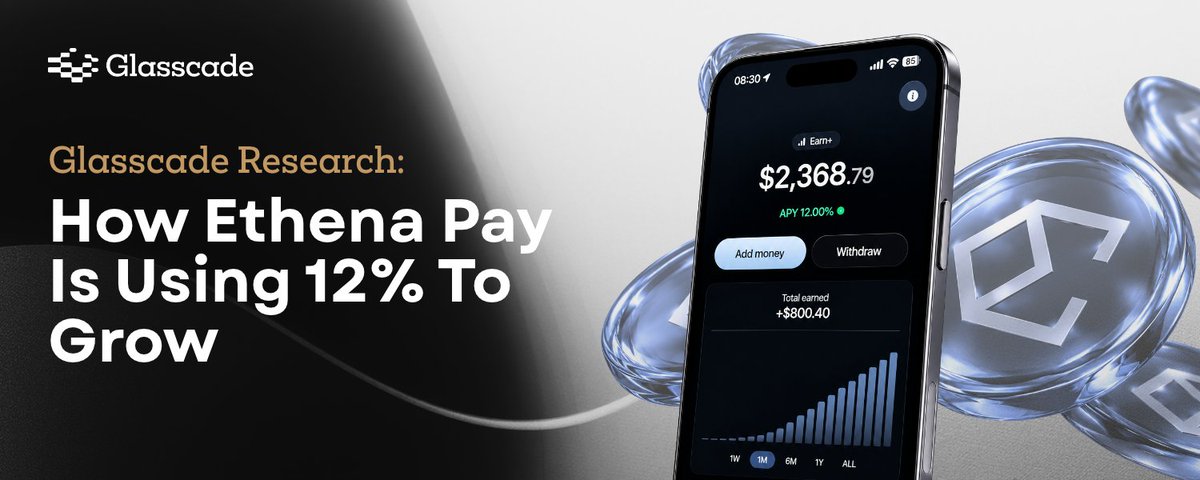
Circling back, let's see how @EthenaPay has performed. Ethena Pay users now hold $17.6M in USDe balances and Earn+ deposits, double the $8M+ reported in late October. 11 weeks after $ENA Pay beta, savings are outgrowing the card. $9.15M of that sits in Earn+, already 2x its initial $4.5M cap. The other $8.5M is in liquid USD balances, which kept rising as Earn+ filled, so the demand for yield within the card program is proven. The card is still growing underneath: • October volume doubled to $3.13M • Transactions grew faster, from 17,387 to 41,577 • Average ticket fell from $91 to $75, a sign of everyday spending It's broadening too. In the week of Nov 9, 89% of the 1,130 spending addresses were returning users, and the bottom 90% of spenders drove 48% of volume, up from 30% in late September. Here is how spending could push higher. Only 2,077 of 17,562 registered accounts are funded, so close to 9 in 10 sign-ups haven't deposited yet. On top of that, the app is iOS-only across ~50 countries, with Android, the US and the EU still on the roadmap. At this point, its quite clear that Ethena built a savings account people actually fund. The card is how that turns into spend, and then into the $ENA bid.
Glasscade @Glasscade_xyz Nov 3 Article Glasscade Research: How Ethena Pay Is Using 12% To Grow Following our pieces on Ethena Pay, Whitelabel and core USDe supply, we look at Earn+, the 12% vault that Ethena Pay just launched. We cover how the yield works, what it costs, and why we see it as a
First $BP Then $LIT? Very bullish news for those who're into the crypto-tradfi bridge Sets a good precedence that things like this CAN happen
Backpack is coming home to the USA. 🇺🇸 We’ve received landmark CFTC approval to establish the first-ever derivatives exchange powered by one order book with unified global liquidity. Leveraged perpetuals. Crypto collateral. Cross-margin. 24/7 trading. Join the waitlist: backpack.exchange/us LFG 🎒
The hardest part of holding gold on-chain is that almost none of it gets used. In Jul, @redstone_defi found only ~$63M of $XAUT and $PAXG posted as collateral on Aave v3 and Morpho, about 1.5% of their combined market cap. The rest sits idle, carrying gold’s 0.1% to 0.5% yearly storage cost and earning nothing. Demand is holding up that even a ~30% drop in Jan record price, tokenised gold is still worth $5.58B, close to the ~$6B ATH. Tokenised commodities are still a small corner of RWAs. @RWA_xyz counted $5.2B of them in Sep, out of $38.6B across all tokenised RWAs, and almost all of it is gold. XAUT ($3.13B) and PAXG ($1.74B) hold ~87% of tokenised gold. Gold itself is a ~$29.6T market, so less than 0.02% of it is on-chain. The protocols below either tap that leasing market, lets you borrow, or mint against gold: • Earning yield on the gold itself 1) @theo_xyz > $thGOLD tracks LBMA gold, backed by MG999, a gold fund run by FundBridge Capital and tokenised by Libeara, which is backed by Standard Chartered > The fund lends gold to retailers such as Singapore’s Mustafa Gold, at roughly 2.3% net at launch 2) @paxoslabs > PAXGy lends PAXG’s reserves into institutional gold leasing > Yield accrues through the PAXGy/PAXG exchange rate > Holders carry borrower-default risk, and exits back to PAXG go through an approval-gated queue. 3) @syncratefinance > SGLD is a Base token backed 1:1 by LBMA-standard bars held in UAE vaults > Had a Bureau Veritas audit of the bars in June > Stake SGLD for syGLD - up to 90 days and the gold behind it is leased to bullion banks • Minting dollars against gold 4) Theo’s thUSD > Holds thGOLD and shorts CME gold futures against it > Holders earn the leasing yield plus the futures basis and carry no gold price exposure 5) @falconfinance > Accepts XAUT as collateral for its synthetic dollar USDf > Runs an XAUT vault paying an estimated 3% to 5% APR in USDf, with a 180-day lock • Borrowing against gold 6) @aave > Lists XAUT on its $AAVE Ethereum Core market in isolation mode. In March it handled its largest cluster of XAUT liquidations without disruption. > XAUT deposits went from about $40M in early Jun to $76.7M by mid-Aug 7) @Morpho > $MORPHO powers Coinbase Borrow’s new PAXG/USDC market on Base, live this month > Gold is the first non-crypto asset Coinbase Borrow accepts as collateral, alongside $BTC, $ETH, $XRP and $SOL The three yield products all draw from the same source. thGOLD, PAXGy and sySGLD all earn by lending physical gold to retailers, resellers and bullion banks. That competition is the reason I’m bullish. More on that soon.

Before launch I also said @Enter_Elysium would follow @RobinhoodCrypto and @arc: NFTs, games and launchpads get filtered out, and lending and stablecoin TVL survive. One week in, the filtering is already happening. > Active DEX wallets fell from 58,654 to 4,627, down 92% > Daily launchpad volume fell 96% over the same days, from $40.5M to $1.55M > TVL in Elysium’s apps is at ~$2M - concentrated within two DEXs, @metricxyz and @aeroxyz ($1.59M between both) Besides, lending apps like @lendcache are sunsetting. Elysium holds $5.24M in USDC, 3.5x everything deposited in its apps, and only about $273K of it sits in DEX pools. So half the call has played out. The dollars have arrived, and they’re waiting in wallets for lending and stablecoin apps to give them something to do.

I said we’d only have 5 revenue-generating launchpads on @Enter_Elysium by the end of launch week. And its pretty difficult to determine since most of these launchpads don’t say what they earn. But at least there's something on the volume side. @ElysiumEco tracks 49 live launchpads, and over the past 7 days 5 of them did 89% of volumes: 1) @MontraXYZ $MONTRA → $82.3M 2) @AscendLaunch → $35.8M 3) @VoltaFamily $VOLTA → $13.3M 4) @Boxa_Elysium $BOXA → $11.1M 5) @eleosfun → $9.4M 30 other launchpads did under $100K each. Volume is the main factor to watch now, cause if this falls then its a quicker goodbyes to launchpads
Honestly, what could bring $STONK back? To me, @LaunchOnSF partially lost its edge when casino king @Pumpfun shipped Custom Pairs and copied $STONK's holder rewards. A month on, it had 58% of stock-paired meme volume on Solana while StonkFun's daily volume slid from about $42M to $13M. The bigger case sits with who StonkFun works for. In the past 10 days it opened pairs for a privacy-sector index, $TKO (the company behind UFC and WWE, issued via Backpack Securities and Sunrise), fractionalised internet domains and a $MAG7 index. StonkFun solved Solana's problem of getting anyone to hold a tokenised asset, and has done this at scale before. From 1 Sep to 11 Oct, its coins drove roughly four-fifths of the $1.76B in stock-paired meme volume on Solana. If issuers keep announcing StonkFun pairs the week they launch, StonkFun becomes their go-to channel for first demand, which is a bigger business than a meme casino. The tokenomics is also cleaner than most launchpad tokens. Fixed supply, no presale, no disclosed team allocation, no unlocks, 22.6% of supply already burned, and around 60% of revenue still buying and burning. $STONK trades at ~3x annualised revenue, versus roughly 5x for $PUMP. At this price, every dollar of fees burns far more supply than it did in Sep. What still has to change is fees. Revenue has slid to about $20K a day, and the reward tax keeps a steady seller on every coin. The new pairs need a runner before any of this shows up in the price.

The memecoin bust that hit $PONS and $STONK in Oct-Nov skipped @Pumpfun entirely. Pump's fees went up. Fees (Sep to Oct): > $PUMP → $45.6M to $62.5M, +37% > $PONS → $140.2M to $17.1M, -88% > $STONK → $31.6M to $8.3M, -74% The liquidity exit everyone now blames arrived later. Stablecoin supply shrank $14.2B over the past 30 days, the biggest drop since 2022, and by then both launchpads were hit hard and had already lost most of their fees. The stock pairing has added a second hit this week, because a meme quoted in $NVDA carries the stock's drawdown on top of its own, and NVDA closes lower alongside the saga. Anyone still holding these tickers?

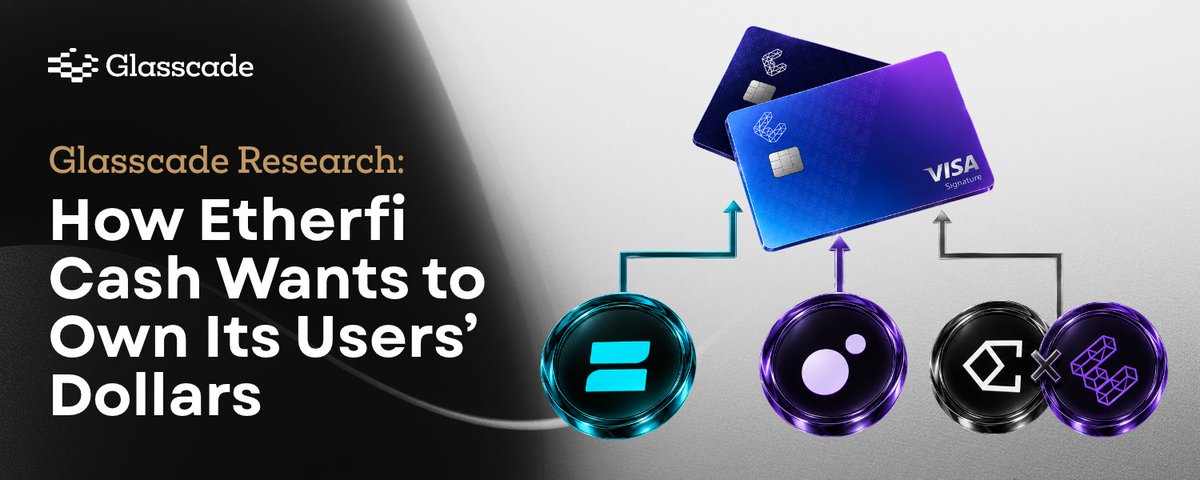
Its obvious how the the competitive landscape of crypto neobanking is gradually shifting from user acquisition towards user retention + stickiness. @ether_fi's Cash product is a pretty good example of this. As highlighted by @glasscade_xyz, Etherfi Cash has surpassed $1B in cumulative card spending, w/ 12.6M+ transactions across 199 countries. But what caught my attention wasn't necessarily the headline volume, it was the underlying growth dynamics. Between April <> October: 🔹 Active addresses grew 67.5% 🔹 Transactions per address increased 31.5% 🔹 Average transaction size declined slightly by 2% In other words, growth hasn't simply been driven by users making larger purchases, but by more people using the card more frequently. And IMO, frequency of usage is one of the more encouraging early indicators of product stickiness. Ofc, perks like cashback, rewards + promotional incentives are fantastic magnets for onboarding users. But these are relatively easy for competitors to replicate, and incentives alone rarely create lasting loyalty. The real challenge is getting users to stay even when the incentives become less attractive. And that ultimately comes down to less tangible factors particularly trust, reliability, convenience + the overall user experience. Does the card work consistently? Is funding seamless? Can users confidently keep meaningful balances in the app? Does the product keep pace w/ changing consumer expectations, security standards + regulatory requirements? These might sound like basic considerations, but they're precisely what separates a promotional spending product from something users genuinely depend on. This is also why Etherfi's recent moves are particularly interesting. 1. The @zealwallet acquisition creates another avenue for onboarding existing crypto card users. 2. The @moonpay integration aims to simplify funding + reduce friction between traditional banking rails and onchain balances. 3. Etherfi USD, built through Ethena Whitelabel could eventually make holding funds within the ecosystem more economically productive for the platform. Individually, these are useful product developments. Collectively, they point towards a much bigger ambition in making Etherfi a place where users don't just spend money, but actually keep + manage it. And that's where I think the real competitive moat begins to form. Because once a financial product becomes embedded in someone's everyday habits, switching becomes less about chasing an extra percentage point of cashback and more about whether the alternative is worth disrupting an experience they already trust. Ofc transaction frequency alone doesn't prove long-term retention, and the impact of these new integrations remains to be seen. But the direction is encouraging. Perks attract users, while product experience builds habits, and trust keeps them around. IMO, the winners of crypto neobanking won't necessarily be those offering the most generous incentives, but those that can consistently deliver a financial experience people are comfortable relying on every day. That's a much harder moat to replicate. Feel free to take a read at this research article for more in-depth insights 👇

Glasscade @Glasscade_xyz Nov 5 Article Glasscade Research: How Etherfi Cash Wants to Own Its Users’ Dollars Etherfi Cash crossed $1B in card spend without owning the dollars its users spend or the rails that fund them. In October, it struck three deals in under three weeks to change that. Here is what each
When price goes up, we realise how underexposed we are When price goes down, we realise how overexposed we are Ah, the duality of man.
That moment when you realize you may have been overexposed to the industry you log in and tweet about on a daily basis
In @Enter_Elysium’s first week, trading terminals earned 3x what the chain did. Their share is already shrinking. @BasedBot, @fomo and @gmgnai collected $315.2K in fees between Nov 9 and Nov 15. The chain’s sequencer earned about $105.9K over its first seven days. Their fee rates differ a lot. GMGN took about 1.08% of its $14.12M in volume. fomo, the chain’s exclusive trading partner, took 0.16% of $20.75M. Most of that came in the first two days. By Friday, terminal volume was down 91% from launch day, from $28.3M to $2.68M, and the three terminals collected $9.5K in fees that day [swap in Monday Nov 16 against launch day, Monday Nov 9]. Terminals earn from the launch-week rush. The chain earns from whatever activity stays, and only that share flows to $KNTQ. (Data: @tehcscreener)


A Vault Is More Than Its APY: Inside @Shift_DeFi I walked through 100 USDC deposit and withdrawal on @Shift_DeFi's Liquid USDC Vault. As of 14 November 2026, it showed a 4.82% APY and ~$1.15M TVL. • USDC is allocated across Morpho and Curve strategies, not held idle • Risk is split into asset, protocol and network, with a Weakest Link cap • Deposits and withdrawals run in batches, and the withdrawal estimate isn't guaranteed A vault is more than its APY. Start here: app.shiftdefi.com/?utm_sourc…
Top 10 card programs ranked by 7D volume change [10th Nov to 16th Nov] 1) @SafePal +25.2% 2) @itstuyo +23% 3) @avax Card +20% 4) @Plasma One +14.2% 5) @KASTxyz +11.0% 6) @Exa_App +9.4% 7) @Karta_Personal +8% 8) @wirexapp +7.5% 9) @useTria +2.6% 10) @Solayer_Pay +2.2% The fastest movers are the smallest books. @SafePal tops the week at +25.2% on $67K; @itstuyo is +23% on $533K. Meanwhile the programs carrying real weight barely moved: @KASTxyz grew +11% but on a $28.6M book, and @wirexapp +7.5% on $16.5M. @Plasma One is the exception: +14.2% on a $31M book. Double-digit growth with real size under it, which is rarer on this week's list.

The memecoin bust that hit $PONS and $STONK in Oct-Nov skipped @Pumpfun entirely. Pump's fees went up. Fees (Sep to Oct): > $PUMP → $45.6M to $62.5M, +37% > $PONS → $140.2M to $17.1M, -88% > $STONK → $31.6M to $8.3M, -74% The liquidity exit everyone now blames arrived later. Stablecoin supply shrank $14.2B over the past 30 days, the biggest drop since 2022, and by then both launchpads were hit hard and had already lost most of their fees. The stock pairing has added a second hit this week, because a meme quoted in $NVDA carries the stock's drawdown on top of its own, and NVDA closes lower alongside the saga. Anyone still holding these tickers?
Tag a friend who needs some weekend alpha👇 @rektdiomedes @Jonasoeth @MeshClans @0xgilllee @0xCheeezzyyyy @crypto_linn @kenodnb @andrewmoh @Eli5defi @yashascore @the_smart_ape @defi_mago @Mars_DeFi @FabiusDefi @Nick_Researcher @TheDeFiPlug @DeFi_Andree