
⟳ NASA JPL retweeted
Nov. 18, 2026, 5:16am EST The Voyager 1 spacecraft has reached a distance of one light-day from Earth.
 Open web. Clear feed.
 ✓
The Jet Propulsion Laboratory advances science and discovery through NASA robotic missions exploring Earth, the solar system, and the universe.
Nov. 18, 2026, 5:16am EST The Voyager 1 spacecraft has reached a distance of one light-day from Earth.

Tonight's the night! 💛 Anytime after sunset, go outside, and join in this once-in-human-history moment by creating a wave of golden light. Learn more at go.nasa.gov/shinebright And find our automated V-G-R flasher at go.nasa.gov/vgr


...- --. .-. Can you decode this message? 🔦 On Nov. 17, celebrate Voyager 1 reaching one light-day from Earth by flashing this message toward the night sky. Join the celebration: go.nasa.gov/4iQtSMS

Tonight's the night! 💛 See below to learn how you can join the celebration, and here's a direct link to the ready-made flasher: go.nasa.gov/vgr
Congrats to the California Science Center on opening the Samuel Oschin Air and Space Center 🚀 In the Kent Kresa Space Gallery, see our legacy of Mars exploration – and try driving a rover yourself! We’re proud to share JPL and Caltech's work with our neighbors right here in Southern California.


As Voyager 1 approaches one light-day from Earth, you can track its position, visualize the time it takes for its messages to reach home, and re-create its tour of the solar system. All it takes is our free, online solar system simulator! Try it out: eyes.nasa.gov/apps/solar-sys…
A tiny bit of light can go a long way. After sunset on Tuesday, Nov. 17, we invite you to “Shine Bright for Voyager’s Light-Day” by lighting a signal skyward, joining a worldwide celebration of this historic moment, nearly 50 years in the making.
No other traveler has ever journeyed so far from home. Voyager 1 is about to become the first human-made object to reach a distance of one light-day from Earth, or about 16 billion miles. ½

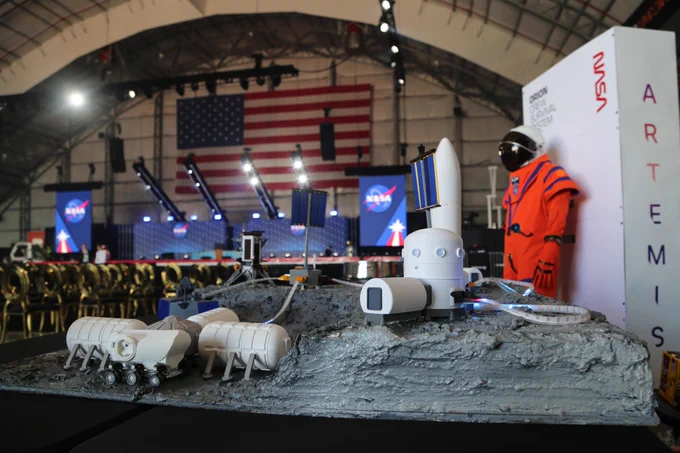
New awards. New mission updates. More progress toward a Moon Base. We're advancing commercial lunar deliveries, a nuclear-powered rover, launch and orbital transfer services, and infrastructure to support a sustained human presence on the Moon: nasa.gov/news-release/nasa-a…
LIVE: Big updates on our efforts to build a Moon Base! @NASAAdmin and agency leaders are sharing the latest progress and new developments toward establishing a sustained human presence on the lunar surface. x.com/i/broadcasts/2ybAenAyp…
We're kicking Moon Base updates into high gear! 🚀 Tune in today at 5 p.m. ET as agency leaders share the latest progress and new developments in our efforts to establish a sustained human presence on the lunar surface. The event will stream live from MAX POWER at @NASAKennedy.

Nice shades. 😎 This sunshade will fly on NEO Surveyor, a spacecraft that will spot nearby asteroids and comets that ground-based telescopes might miss. The sunshade will help by harnessing the Sun’s power and blocking its blinding glare: go.nasa.gov/47Ze1GP

Get more skywatching tips at nasa.gov/skywatching

On Oct. 31, 1936, a group of Caltech students and enthusiasts began rocket propulsion tests in Arroyo Seco, north of Pasadena, CA. Their work 90 years ago marked the beginning of @NASAJPL, now a vital part of NASA's exploration of the solar system and beyond. Happy 90th JPL!!
