A new chapter in proactive wellness begins.
FINAO SPV Inc.- a venture between FINAO and Rubix Blockchain-has collaborated with the YMCA to launch the P0 beta of the YMCA Wellness Café™ in the Pacific Northwest.
The platform encourages members to build healthier habits by rewarding consistent wellness activities with Y COIN, a utility token backed by Rubix tokens.
Powered by the Rubix Blockchain, the platform enables secure activity records, seamless rewards, data privacy and scalable transactions.
With the YMCA serving more than 60 million members across 120 countries, this initiative has the potential to take rewarding, proactive wellness to a global scale.
Read the full announcement:
lnkd.in/d8_q2zhJ
Computer use is becoming faster than humans, and cheaper too
OpenAI's Ari Weinstein: "We've gotten computer use now to a place where it's faster than the average human at using a computer, and I think we're getting really close to a place where it is superhuman."
And it already costs a fraction of human labor per hour of back-office work:
- Computer-use agent: $6-8
- Offshore outsourced talent: ~$10
- US back-office labor: $30-45
OpenAI's computer-using agents can now operate almost any app the way a person does, clicking and typing through software that never got an API, and the team building them says they're close to beating expert humans on speed.
Ari Weinstein works on OpenAI's consumer computer use products, and James Sun works on the enterprise side. Both were startup founders before joining OpenAI.
They join a16z's Seema Amble and Fabrizio Serafini to discuss what OpenAI's Astra model changed for computer use, the controls enterprises need for agents they can no longer watch, why computer use works as a universal API for legacy ERPs and finance systems, and why they think cheap software will push UI to get better and more personal.
0:50 What Astra changed for computer use
3:23 Consumer vs. enterprise computer use
5:43 How James runs his workday with Dots
8:06 When computer use becomes superhuman
10:01 How much autonomy to give agents
11:36 What agents mean for ad-supported sites
13:51 Computer use as the universal API
17:21 Getting enterprises to trust agents
20:22 Why the best use cases are the boring ones
25:37 Why UI isn't going away
32:38 Advice for founders building on agents
37:31 Making computer use feel coherent
40:57 Computer use's scaling moment
YouTube: youtu.be/9v42ZOdiBJY@AriX@JamesZmSun@OpenAI@seema_amble@fabserafini
Banking infra is only as secure as the identities accessing it.
We help global banks strengthen access security through:
🔐 Phishing-resistant @ThinC_AUTH FIDO2 Keys
🔗 Machine & key binding through AMS.
🛡️ Enterprise identity & access through @XSenseID .
📩sales@ensurity.com
Agree, banks have a big fraud and liability issue to address. Some big unanswered questions:
1. If the user denies the agent action, how does bank prove the user did give consent.
2. How does the bank prove user gave the credential willingly and not misused by the agent.
3. Is the agent a legitimate rep of the user or a hacker who stole credentials
4. Is the intended action approved by the user even if credential shared. How is the intent verified dynamically?
5. Agents by design would like to have the broadest intent (even users may be ok), but how does bank enforce explicit auth from user when it wants.
6. Did the agent create sub agents to act ?
7. Is the agent prompted to do a malicious activity.
Even as banks are trying to deal with agentic actions, AI is making passwords and biometrics themselves highly risky. We need to ensure the hardened user root of trust (eliminate passwords) to pass onto agents and enforce continuous auth. And treat agentic actions as not simple key or x406 certain based auth, but derived from continuous DNA. KYA and KYH will need to replace KYC.
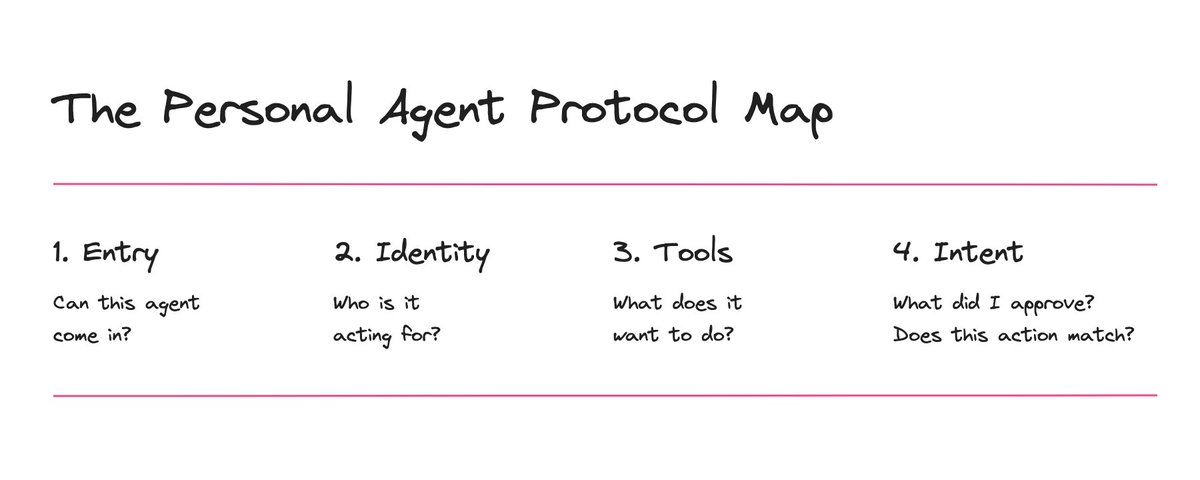
Your agent looks like a giant fraud and liability problem to your bank.
Even if you sent it.
The bank needs to know who it’s acting for and whether you approved what it’s doing.
I mapped the protocols that could make this work:
API keys and registry credentials mostly compromised. Roll out new keys, but need access first. Account takeovers can be hard to reverse. Harden and airgap API keys and all credentials before its late. @ThinC_AUTH#AuthAMS@Ensurity
Railway is compromised, rotate all API keys as soon as possible
Deployments are down so don’t wait to redeploy
Attackers are draining keys in real time, we didn’t lose much but can confirm this is still an active attack
Stay safe friends
This is alarming. Hackers could gain root access before patching is done and maintain persisent presence inside. Focus must be to comprehensively fix auth before that. @EnsurityTech@Agent_DNA
The window to patch software bugs is collapsing
Of the bugs hackers actually exploit, ~87% are now being attacked on or before the day the bug is public knowledge
That share was 23% in 2020
Charts of the Week: a16z.news/p/chart-of-the-wee…
Crazy 72 hours in security. Three major incidents dropped back-to-back: eMudhra, PingCAP (TiDB Cloud), and PHP.
Here is the short version of what happened and who got hit.
1. eMudhra (Trusted CA compromise)
eMudhra generated 8 intermediate CA certificates in April 2025 (cross-signed by Sectigo). A bug in their HSM key-wrapping test script created a second set of P-384 keys where the private keys were single-byte numbers under 256. Operators picked the wrong key labels and signed them into real CA certs.
One of the intermediate CA private keys was literally the number 4.
The other seven: 56, 66, 115, 155, 156, 230, 237.
Three weeks later (May 2025), their CRL signatures started failing because the CRL signer was using the real keys instead of the weak ones. Instead of asking why the keys didn't match, someone switched the CRL signer to the weak keys and closed the ticket.
• Browsers are safe: Chrome, Firefox, Apple, and Microsoft already blocked them, and zero rogue certs hit CT logs.
• Servers are not: curl, Python (certifi), Go binaries, and Docker base images don't check CRLs. Update ca-certificates, certifi, and Go (1.27.3 / 1.26.10).
• 10-second check on any server:
curl dv-g3b-emudhra.we-have-a-pro…
(TLS error = safe. 200 OK = still vulnerable.)
2. PingCAP / TiDB Cloud (10.6 TB breach)
Attackers found GCP and Azure credentials committed inside PingCAP's own repos. They set up a replication feed of TiDB Cloud's production control plane and exported the entire database every 6 hours for 22 straight days. 88 full exports, zero alerts. 200 GB is already out on torrents.
Beyond the 413 private repos and 20.6M customer SQL queries logged from their web SQL Editor, PingCAP engineers were pasting customer secrets into Jira tickets.
Who is affected in the leaked records:
• Live credentials exposed in support tickets:
- Pinterest: AWS keys for their pingcap-logs S3 bucket
- CardX / Silverlake (NPCI-linked env): AWS admin key in a backup log with full access to 258 external S3 buckets
- DeBank: 38 presigned S3 URLs
- An unnamed AI/dev platform: a 314 MB slow-query log attached to a ticket containing 8,027 live customer secrets (an AWS root key, a GitHub admin PAT over 1,701 repos, 7,485 AWS STS tokens, and 192 OpenAI/Anthropic/Gemini keys)
• Tenants with infra metadata, VPC CIDRs, app-server IPs, or contract pricing exposed:
- Tech: Atlassian, Databricks, Airbnb, Baidu, LINE, Nylas, Persona, PatSnap
- E-comm & Travel: Booking.com, Shopee, Flipkart, Mercari, ZOZO, AEON, Delhivery, Klook
- Gaming: Capcom, Square Enix, Konami, Bandai Namco, Cygames, Colopl, DMM
- Finance: PayPay, SoftBank, SBI, SB Payment Service, Fujitsu, TOPPAN, Bank of China, China Life
- Crypto: Bitget (said only public trade logs were on it and they already left), Pionex, DigiPlus, NFTscan, Chainbase
• Developer profiles leaked (from a purchased reo.dev table in PingCAP's BigQuery):
- 24,900 personal emails + GitHub/LinkedIn profiles of engineers at Tencent (3,327), Huawei (2,726), ByteDance (2,475), AIG (2,140), Mastercard, Flipkart, and bKash.
If you use TiDB Cloud: rotate your console API keys, DB passwords, and anything you ever pasted into a support ticket.
3. PHP "PHP2Shell" (CVE-2026-109618 & CVE-2026-109619)
Two CVSS 9.2 pre-auth RCEs leaked yesterday ahead of today's 14:00 UTC patch.
Public writeups trace it to a heap Use-After-Free in PHP's native C multipart/form-data session upload-progress handler (ext/session/session.c).
Because C-level multipart parsing runs before line 1 of index.php:
• App auth, Laravel/WordPress middleware, and file_uploads = Off do not stop it.
• Only PHP 8.2–8.5 get official patches today (59% of PHP servers on Shodan are on EOL <= 8.1).
• Until you patch php-fpm: lock php_admin_flag[session.upload_progress.enabled] = off and block unexpected multipart requests at Nginx/Apache/Cloudflare.
Has anyone scanned the internet for ECC public keys (and even RSA) and tried all private keys up to 256 to see if this is a more common phenomenon than imaginable?
@nadiaheninger ?
It is 2026 and we are still seeing breaches due to credential theft and passwords, with wide blast surface. Two choices: harden/airgap creds. Or decentralize creds. Little time left to make this transition.
@EnsurityTech@ThinC_AUTH#AuthAMS@Agent_DNA
WE DIDN'T JUST RETHINK AUTHENTICATION. WE REDEFINED TRUST.
Identity is managed through @XSenseID . Credentials & assets are controlled through AUTHAMS, Authentication is strengthened through our @ThinC_AUTH FIDO2 Bio Keys.
#UnPhishYourself with Ensurity.
📷sales@ensurity.com
Gavin Baker on the other side of Ben's bandwidth story: at the peak of the 2000 bubble, 97% of America's fiber sat dark, and today there are no dark GPUs.
"I had, depending on how you look at it, the privilege and the misfortune of being a tech investor during the year 2000 bubble, which was really a telecom bubble."
"The year 2000 bubble was defined by something called 'dark fiber.' Dark fiber was literally fiber that was laid down in the ground, and not lit up... At the peak of the bubble, 97% of the fiber that had been laid in America was dark."
"Contrast that with today. There are no dark GPUs. All you have to do is read any technical paper, and one of the biggest problems in a training run is that GPUs are melting."
@GavinSBaker
Ben Horowitz on the lesson LoudCloud, his early cloud company, taught him about today's AI neoclouds, and why they now face the opposite problem:
"It can end up being like a very dangerous arbitrage business, where you can get upside-down easily. And so if you look at LoudCloud, just as an example, here's a simple thing that happened to us."
"In 1999, bandwidth was $1,500 a megabit. And you couldn't get it. It was very hard to get it. And so you had to get a long-term contract, three years. By 2001, it was $50 a megabit... And if you borrowed money to get it, you're dead."
"That kind of thing is so out of the control of the entrepreneur."
"I think the core dynamic of AI has been working for CoreWeave, though, in that there's a massive shortage, not an overage of supply... Token prices have gone down, but GPU prices have not."
"And by the way, data center space is going up in price because even labor to build data centers is hard. The politics are making it hard to build data centers. So the whole supply chain price is going up and demand is not subsiding."
"Those are very big tailwinds for CoreWeave, despite the fact that the debt markets, kind of independent of them, are tough."
@bhorowitz w/ @chamath on @allinpod
Agree @elonmusk, HBM is a tougher one to scale quickly. Unlike previous memory cycles though, falling prices and context efficiency will lead to more expoential demand.