Life Update: Last month I started as a Postdoctoral Researcher at Microsoft Research India!
If you are curious on why I chose to return to India after my PhD from Canada; I've written some personal thoughts about it!
Introducing e-means, an algorithm beating k-means in 10x fewer epochs.
With order of magnitude wall-clock speedups, e-means is released in FAISS and needs no hyperparameter tuning beyond k. It is robust to various scales and datasets. Still skeptical ? Just try e-means [1/10]🧵
Is there a way to scale a reasoning model’s judgment for searching a massive corpus?
We introduce the Amortized Reasoning Index (ARI), a new kind of retriever that updates its weights during search, using gradients derived at inference time from the ranking preferences of a reasoning model.
Every session, current agents spend lots of reasoning deciding which search results matter, and then throw all of that judgment away upon compaction. ARI is our attempt to “amortize” that judgment, so that reasoning spent on past queries keeps improving search on future ones.
With no relevance labels, ARI takes a 400M cross-encoder that starts out weak and grows its Recall@100 on held-out queries by up to 7×, ending above Qwen3-Embedding-8B on various oblique/reasoning-intensive search tasks.
Read our blogpost: dianetc.com/musings/ari/
Preliminary results and discussions are below!
Introducing Inkling 2 Small. Scoring 31 on the AA Intelligence Index, it's a big jump over its predecessor.
Inkling 2 Small is available for fine-tuning and inference on Tinker today, with full weight release planned soon.
thinkingmachines.ai/news/ink…
Official now! 🚀
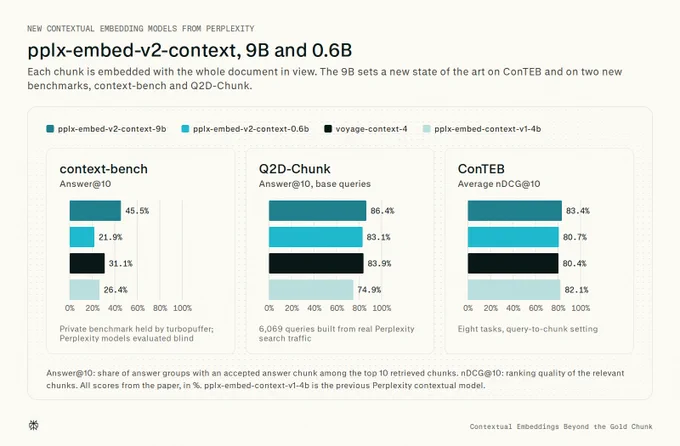
Excited to share the outcome of a project I'm particularly excited about. We're introducing a SOTA int8-quantized contextual embedding model, a public leaderboard for chunk retrieval evaluations, and exploring our model's potential for visual document retrieval.
Introducing pplx-embed-v2-context: open-weight vision-language embedding models in 9B and 0.6B.
Both return one int8 vector per document, or one per chunk that sees the whole document.
Read the paper, written with @turbopuffer: arxiv.org/abs/2610.38854
With agents, one thing I'm seeing nowadays is reproduction happens effortlessly (ofcourse with supervision)!
but back in the days, manually understanding someone's code + making sure you are faithful to the setup + lots of pain and effort.
i've reproduced the results from the MIT blog post today on weight-space programming. but one additional result i have to add: this is a new, step-change emerging capability that's appeared in just the latest set of models.
you thought LLMs can only do text optimization and discovery for prompts, harnesses, and code?
turns out they’re starting to be good at natively reasoning about and writing out neural network weights directly too
in the limit, where does this leave symbolic local optimization heuristics like gradient descent…??
We asked GPT-6 Astra to edit Qwen3.5-0.8B weights to improve math.
It directly changed only 0.016% of weights, fixing 0.8B's reasoning loops & improving math up to 6x and even instruction following 3x, without gradients or training.
We call this Weight-Space Programming: frontier LLMs can now natively read/write neural network weights! 🧵
Blog: rikiyat.github.io/blog/weigh…
If this result holds up, it's a huge moment for computer architecture. We're already exploring machines that aren't programmed declaratively, but are trained. Their programming are their weights. Having weights as a direct output of knowledge is a HUGE shift in representation!
We asked GPT-6 Astra to edit Qwen3.5-0.8B weights to improve math.
It directly changed only 0.016% of weights, fixing 0.8B's reasoning loops & improving math up to 6x and even instruction following 3x, without gradients or training.
We call this Weight-Space Programming: frontier LLMs can now natively read/write neural network weights! 🧵
Blog: rikiyat.github.io/blog/weigh…
We asked GPT-6 Astra to edit Qwen3.5-0.8B weights to improve math.
It directly changed only 0.016% of weights, fixing 0.8B's reasoning loops & improving math up to 6x and even instruction following 3x, without gradients or training.
We call this Weight-Space Programming: frontier LLMs can now natively read/write neural network weights! 🧵
Blog: rikiyat.github.io/blog/weigh…
We asked GPT-6 Astra to edit Qwen3.5-0.8B weights to improve math.
It directly changed only 0.016% of weights, fixing 0.8B's reasoning loops & improving math up to 6x and even instruction following 3x, without gradients or training.
We call this Weight-Space Programming: frontier LLMs can now natively read/write neural network weights! 🧵
Blog: rikiyat.github.io/blog/weigh…
Good slides are extremely intentional. When someone presents a paper, the paper already has all the information. But the speaker would make deliberate choices about things like, what to say and what not to say, what to put on a slide and what to say only verbally.
What to frame as a "side note" and when to say "this is the part I found particularly exciting."
Even individual word choices, like the subject, verb, and adjective, and when to pause, are intentional.
In fact, a good speaker would never really give a talk about a paper, even when that's seemingly what they're doing.
They would talk about what they want to say, like the story they want to tell, the kind of research they like, the vision they have, etc. Then they use the paper to support / back up their message.
Some tools are perfectly fine to use. But some skills take so much time and efforts, like years, and some tools proactively prevents learning them.
my hypothesis for why AI-generated slides for technical presentations are so awful:
people who don't have a lot of experience presenting think that to make a talk you just put all of the stuff you want to talk about on the slides, then you go through each slide and say the stuff the slide says.
how you're actually supposed to prepare a presentation: you decide what to say, write it out as a rough script, then put maybe 3% of the text on the slide, plus a bunch of visual aides (e.g. plots that only include data you're planning to discuss).
AI-generated presentations are mostly the former. they have a ton of stuff the presenter never mentions, and the stuff that is most useful for the presenter is absent or not highlighted. they include enough content for a presentation 10 times longer than the actual presentation is supposed to be.
maybe try doing it the other way: first write the script for what you actually want to say, and make sure you can say all of it in the time you have. then prompt the model to create the slides based on the script. ask it to use as little text a possible, and a minimalist visual style rather than the claude house style. you can thank me later (I accept both venmo and zelle).
Very proud on our Series E.
When joining Cohere 4+ years ago, AI was still a niche product people barely cared about, and thought LLMs are just for auto-complete like your phone does it.
Like AI, search drastically changed in the time window. My org build the best retrieval systems on the market. We first build them for human users, but now AI agents are our largest users: We had to re-think what makes search great for AI.
Search / finding knowledge / managing knowledge remains still an open and challenging problem, and we are looking forward to the next generation of models & products in that space.
We're proud to announce the initial close of our Series E, targeting up to CAD $7 billion at a CAD $35.7 billion valuation; marking the largest private financing round in Canadian startup history.
Love BrowseComp-Plus? Meet 𝐂𝐌𝐀𝐒𝐒! 🚀
cmass.tech
🔥Your next challenge for agentic search: 423 question–answer pairs spanning BrowseComp-Plus, DeepSearchQA, Total Recall QA, and HotpotQA—all projected onto ClimbMix, a realistic corpus of over 550M documents.
One more take: Hokkaido japanese restaurant in Indiranagar is very underrated: very authentic sushi, rolls and butter squid!
Much much better than Shiro in UB City (please avoid) and other sushi places in Indiranagar and around.